



HDPE Equal Tee Butt Fusion Fittings
Where a run has to put a branch into an existing main, the butt fusion tee is the component that decides the joint's strength. The body is a single moulding with the coil already in the socket wall; the branch does not neck down, the bore is continuous through the junction, and the crew finishes the whole thing with the same welder they use everywhere else. In practice it is welded with the machine the crew already carries, so adding one to a job means no new equipment and no second procedure on site.
The technical case for this version: Equal-diameter butt-fusion tee with three ends in the same diameter, butt-welded in one piece. Three ports identical in size, suitable for main line equal-diameter branching, compared with reducing tee.
Specification summary
|
Body material |
Virgin PE100, moulded in one piece |
|
Available sizes |
DN40-DN1600 |
|
Jointing method |
Butt fusion (hot plate welding) - welded with a standard butt fusion machine |
|
Standard colour |
Standard black with UV stabiliser; gas service supplied with the yellow marking |
|
Media |
Equal-diameter branching of large-diameter gas, water supply and industrial piping |
|
Branding |
Body marking, packaging and labelling to your specification |
|
Standards |
PE100; ISO 4427 / EN 12201 / GB/T 13663 / DIN 8074-8075 |
|
SDR |
SDR9 / SDR11 |
|
Certification held |
ISO 9001:2015, CE, SGS |
|
Pressure rating |
SDR9 = PN20 · SDR11 = PN16 (water, 20 C, per ISO 4427-2 / EN 12201-2) |
|
Markets served |
Europe, Middle East, Southeast Asia, Australia, South America, Africa |
Equal Tee Dimension Drawing
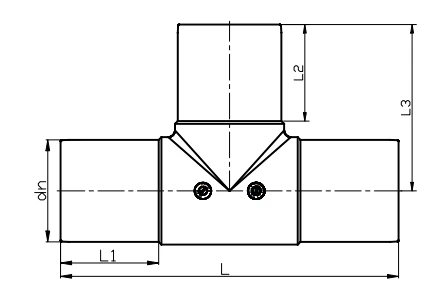
Butt fusion tee dimensions, dn40 to dn1600
The table below is the full Style B range read off our own drawing: run bore depths L1 and L2, branch bore depth L3 and the centre-to-end length L, for every size from dn40 to dn1600 in SDR11 and SDR17. Size, wall class and the three socket depths are the numbers that decide whether the tee welds into your line.
| Size (dn) | L1 - run bore depth (mm) | L2 - run bore depth (mm) | L3 - branch bore depth (mm) | L - centre-to-end (mm) |
|---|---|---|---|---|
| dn40 | 49 | 50 | 80 ±5 | 162 ±5 |
| dn50 | 55 +5/0 | 55 +5/0 | 92 ±5 | 184 ±5 |
| dn63 | 63 +5/0 | 63 +5/0 | 107 ±5 | 213 ±5 |
| dn75 | 70 +5/0 | 70 +5/0 | 120 ±5 | 240 ±5 |
| dn90 | 76 +5/0 | 76 +5/0 | 140 ±5 | 268 ±5 |
| dn110 | 82 +5/0 | 82 +5/0 | 150 ±5 | 300 ±6 |
| dn125 | 87 +5/0 | 87 +5/0 | 163 ±5 | 326 ±6 |
| dn140 | 85 +5/0 | 92 +5/0 | 175 ±5 | 336 ±6 |
| dn160 | 98 +5/0 | 98 +5/0 | 197 ±5 | 396 ±6 |
| dn180 | 82 ±5 | 92 +5/0 | 200 ±5 | 380 ±6 |
| dn200 * | 112 +5/0 | 112 +5/0 | 238 ±5 | 475 ±8 |
| dn200 | 107 +5/0 | 112 +5/0 | 235 ±5 | 440 ±8 |
| dn200 | 107 +5/0 | 110 +5/0 | 226 ±5 | 445 ±8 |
| dn225 | 120 +5/0 | 120 +5/0 | 250 ±5 | 500 ±8 |
| dn250 | 129 +5/0 | 129 +5/0 | 283 ±5 | 565 ±8 |
| dn280 | 136 +5/0 | 136 +5/0 | 304 ±6 | 602 ±8 |
| dn315 | 150 +5/0 | 150 +5/0 | 335 ±6 | 670 ±8 |
| dn355 | 164 +5/0 | 164 +5/0 | 360 ±6 | 720 ±10 |
| dn400 | 140 +5/0 | 155 +5/0 | 380 ±6 | 720 ±10 |
| dn450 | 185/130 +10/0 | 180 +10/0 | 445 ±10 | 890/775 ±12 |
| dn500 | 230/130 +10/0 | 230 +10/0 | 510 ±10 | 1025/835 ±12 |
| dn560 | 230/140 +10/0 | 230 +10/0 | 545 ±10 | 1075/905 ±15 |
| dn630 | 230/140 +10/0 | 240 +10/0 | 600 ±10 | 1175/995 ±15 |
| dn710 | 165 +10/0 | 205 +10/0 | 615 ±10 | 1150 ±15 |
| dn800 | 165 +10/0 | 195 +10/0 | 660 ±10 | 1260 ±15 |
| dn900 | 180 +10/0 | 200 +10/0 | 710 ±20 | 1370 ±25 |
| dn1000 | 190 +15/0 | 230 +15/0 | 800 ±20 | 1500 ±25 |
| dn1200 | 220 +15/0 | 280 +15/0 | 950 ±20 | 1780 ±25 |
| dn1600 | 250 +20/0 | 320 +20/0 | 1200 ±20 | 2220 ±30 |
Reading the tolerances: a figure printed +5/0 is a deviation pair - the printed number is the minimum, and the upper limit is that number plus five. A figure printed ±5 is symmetric. On L2 the allowance steps up with size: +5/0 to dn400, +10/0 from dn450 to dn900, +15/0 at dn1000-dn1200, +20/0 at dn1600. All dimensions are in millimetres.
Notes: dn450 and above can be supplied in two length versions, printed as a / b (890/775 reads 890 mm for version a against 775 mm for version b). dn200 marked * is the one-piece moulded body; the drawing lists three dn200 rows, so tell us the pipe SDR and we confirm which one applies before the order is released.
L1 and L2 are the two in-line run depths and L3 the branch depth, so the table also tells you where the body stops being symmetrical: the two run depths match up to dn125 and start to differ from dn140 (85 against 92), at dn180 (82 against 92), at dn400 (140 against 155), and above dn400 they diverge outright - dn450 prints 185/130. That is why a large tee cannot be welded by measuring one side and copying it to the other.

The figures that govern the joint are the socket depths; the balance sets the trench geometry. Anything not listed here, including intermediate SDRs, is produced to order.
The figures that govern the joint are the socket depths; the balance sets the trench geometry. Anything not listed here, including intermediate SDRs, is produced to order.
What we need from you
Two numbers govern everything here: the socket depth, which is the welded length and therefore the joint strength, and the branch height, which fixes where the branch lands relative to the main centre line. Overall length only affects how much trench you open.
Where it is used
This fitting is specified for equal-diameter branching of large-diameter gas. In practice that covers:
- Temporary bypasses during a mains replacement programme
- Water supply and industrial piping
- Trench junctions where two runs leave a single feed
- New service take-offs from an existing distribution main
- Meter and valve chambers, where the branch has to land inside a confined space
Material data and approvals
The fitting is a single PE100 moulding - no welded-in inserts, no secondary assembly. Built to PE100; ISO 4427 / EN 12201 / GB/T 13663 / DIN 8074-8075. If your specification cites a different one of those standards, tell us at enquiry and the declaration is issued to match. Certification: ISO 9001:2015, CE, SGS - supplied as a document pack with the shipment when your buyer asks for it.
MOQ and lead time negotiable per size and order quantity, confirm on inquiry
Used with
Mating parts: PE100 HDPE pipe, butt fusion welding machine, facing tool, heating plate or clamping tools.
FAQ
Q: What is the difference between equal and reducing branch fittings?
A: An equal tee keeps all three ports at the same diameter, so the branch carries the same bore and pressure class as the main run. A reducing tee steps the branch down, which removes a separate reducer and two welds from the assembly.
Q: What sizes can you supply?
A: The range runs across DN40-DN1600. Tell us the pipe diameter and SDR and we will confirm the socket depth and the overall dimensions before you order.
Q: Which pressure class should I specify?
A: Match the fitting to the SDR of the pipe you are welding it into. SDR9 = PN20 · SDR11 = PN16 - a mismatch changes the wall thickness at the joint face and is the most common cause of a failed fusion.
More from the range
- HDPE Butt Fusion Tee
- 18 Butt Fusion Tee
- Butt Fusing Tee 280mm
- Electrofusion coupling - straight-line joints in the same range
Our HDPE Equal Tee Butt Fusion Fittings is moulded and tested in our own factory. Qingfa Industry has produced PE100 fittings for 25 years and today runs over 3,000 product varieties. Meet the manufacturer behind these fittings.
Hot Tags: HDPE Equal Tee Butt Fusion Fittings, HDPE Equal Tee Butt Fusion Fittings dn40-dn1600, HDPE Equal Tee Butt Fusion Fittings SDR9/SDR11, HDPE Equal Tee Butt Fusion Fittings dn40-dn1600 SDR9/SDR11, PE100 hdpe equal tee butt fusion fittings, hdpe equal tee butt fusion fittings supplier, HDPE Butt Fusion Equal Tee, High Density Polyethylene Tee, HDPE Butt Fusion Equal Tee 45, HDPE Equal Tee Butt Fusion Fittings, butt fusion tee, HDPE Butt Fusion Equal Tee 90
You Might Also Like


Send Inquiry