



DN1400 PE Electrofusion Coupler – SDR17 PN10, PE100
A DN1400 electrofusion coupler is the straight joint for PE100 trunk pipe when the line is already in the ground and neither pipe end can be moved. The copper coil is moulded into the coupler bore, so the weld happens inside the fitting and both pipe ends stay exactly where the survey left them.

A DN1400 PE100 coupler at the works: fusion indicator pins around the body and the weld data label on the bore. Diameter, wall series and the weld programme are carried on the fitting itself.
When a 1400 mm joint has to be fused
At this diameter the pipe arrives by crane, the two ends are set by the survey, and neither run is going to move because a welding machine needs the room. Electrofusion turns that around: the fitting is the only part that changes shape, so both pipe ends can stay exactly where they are while the joint is made.
- A section tied in behind a live line, where the new length is already backfilled.
- A repair cut between two anchor blocks, with nothing left to pull against.
- Connections inside a chamber, pump room or district station too tight to swing a hot-plate carriage into line.
- Road, rail and river crossings pulled in and finished from one end.
- Joints landing at the end of a shift beside a thrust bore, valve assembly or existing tee.
Moulded in one shot: how a DN1400 body is made
A coupler of this size cannot be built up from parts. It is shot in a single cycle on a large press, and the machine has to fill the cavity before the melt starts to set - which is why the number of factories able to quote DN1400 at all is short.

The press used for over-sized PE fittings. According to the machine's manufacturer, 90,000 kN clamping force and a 2.1 million gram shot weight - enough for a PE moulding up to Ø2000 mm. We offer single-piece moulding to dn1600.
The range runs DN20 to DN1400 across 42 injection presses, with CNC machining and automatic welding equipment in-house and an annual PE fitting capacity of around 10,000 tonnes. Yuyao, Zhejiang - Hemudu Town, an hour and a half from Ningbo port.
- Virgin PE100, no regrind. The wall thickness and the coil position stay repeatable across a 70-fold size span.
- Coil cast in during the same cycle. There is no gap between coil and polymer for a local hot spot to start in.
- Label moulded with the body. Size, wall series, voltage, fusion time and cooling time travel with the fitting, so a site in another country runs the same programme we do.
- Every batch tested, not sampled. Fusion and pressure checks in our own accredited laboratory before the batch is released.
- Branding settled at the tooling stage. Your mark is cut into the mould itself, carton and pallet are made to your artwork, and the paperwork is issued in the language your customer reads.
Data sheet: DN1400 PE100 straight coupler
Properties of the DN1400 coupler covered by this page
| Group | Property | Value |
|---|---|---|
| Product | Type | HDPE electrofusion straight coupler (equal coupler), DN1400 |
| Product | Material | 100% virgin PE100, black and UV stabilised; gas-grade yellow on request |
| Product | Jointing method | Electrofusion, barcode-controlled weld cycle, any compatible electrofusion machine |
| Bore | Heating element | Copper coil cast into the polymer during moulding, along the full socket depth |
| Bore | Weld completion | Indicator pins |
| Size | Nominal size | DN1400 |
| Size | Wall series | SDR17 (PN10) as standard; SDR11 (PN16) quoted on enquiry |
| Size | Section figures | Ø D, L1 and L confirmed from the DN1400 drawing with the quotation |
| Duty | Standards | ISO 4427 / EN 12201-3 (water supply); ISO 4437 / EN 1555-3 (gas); GB 15558.2 for the Chinese market |
| Duty | Service life | 50 years and over at rated pressure and temperature |
| Order | Custom service | Own logo moulded in, carton and pallet specification, production scheduled against your delivery date |
| Wall series | Pressure class | Where it is specified | Status at DN1400 |
|---|---|---|---|
| SDR17 | PN10 | Gas distribution, water trunk mains and pressure classes up to PN10 | Tooling finished. Volume output from mid-October 2026 - it can be written into a project schedule now. |
| SDR11 | PN16 | Higher-pressure mains and specifications that call for the heavier wall | Quoted on enquiry. Give us the duty pressure and we confirm the fitting before you specify it. |
Section figures: Ø D, L1 and L
SDR is a wall-thickness ratio rather than a pressure: the lower the number the thicker the wall, so SDR11 is the heavier PN16 series and SDR17 the PN10 one. Every figure in the table is in millimetres, and the three columns answer three different site questions - how wide the trench has to be at the coupler, how deep the chamber is, and how much room to leave between two fixed pipe ends. The same three figures are published for every size the coupler range covers, from DN20 up; the table below gives the part of it nearest DN1400, in both wall series.

Measuring points on the section: D taken across the body, L1 for the depth of each socket, and L for the full length. The label diagram beside it is the same information the welding machine reads off the barcode - voltage, fusion time and cooling time.
Published section figures, DN800 to DN1200 in both wall series, given so a trench or a chamber can be sized before the enquiry
| Nominal size | Wall series | Pressure class | Ø D (mm) outside diameter |
L1 (mm) socket depth, each end |
L (mm) overall length |
|---|---|---|---|---|---|
| DN800 | SDR11 | PN16 | 954±5 | 235±3 | 470±5 |
| DN900 | SDR11 | PN16 | 1080±8 | 260±3 | 520±5 |
| DN1000 | SDR11 | PN16 | 1200±8 | 290±3 | 580±5 |
| DN1200 | SDR11 | PN16 | 1440±8 | 335±3 | 670±5 |
| DN800 | SDR17 | PN10 | 905±5 | 230±3 | 460±5 |
| DN900 | SDR17 | PN10 | 1020±8 | 260±3 | 515±8 |
| DN1000 | SDR17 | PN10 | 1133±8 | 290±3 | 580±8 |
| DN1200 | SDR17 | PN10 | 1360±8 | 335±3 | 670±8 |
DN1400 beside DN1200: what the step up changes
A project that has run DN1200 before will find the method familiar and the logistics are not. This is the list we go through with a contractor moving up a size.
| What changes | DN1200, SDR17 | DN1400, SDR17 | What it means on site |
|---|---|---|---|
| Body outside diameter | 1360 mm, from the published chart | From the DN1400 drawing | Trench width and chamber size follow this figure, not the pipe outside diameter |
| Pressure class | PN10 | PN10 | The design pressure of the line does not change with the size |
| Section figures | Published, DN800 to DN1200 in both wall series | From the DN1400 drawing, with the quotation | Trench can be sized now; hold the chamber detail until the drawing is confirmed |
| Production status | Standard production, held against repeat orders | Volume production from mid-October 2026 | Schedulable now, but ordered against a date rather than drawn from stock |
| Delivery and handling | Palletised, moved by two people and a barrow | Crane or telehandler | The coupler is rigged the way the pipe is rigged |
| Alignment | Standard clamps for the size | Larger clamps and more support points | Both pipe ends need supporting so that no bending stress crosses the socket |
| Weld cycle | Fusion and cooling time from the label | Fusion and cooling time from the label, both longer | The cooling window has to be planned inside the shift - it cannot be cut short |
| Weather exposure | Cooling period is short | Cooling period is long | Wind and rain cover over the joint area for the whole cycle |
What the barcode decides, and what the crew decides
The welding programme is not typed in by hand. Voltage, fusion time and cooling time are printed on the body and read by the machine, so the cycle for this diameter cannot be set wrong at the panel. What is left to the crew is the condition of the pipe and the way the assembly is held while the cycle runs.
Carried on the fitting
- Size, wall series and the weld data label, moulded or printed on the body.
- Voltage, fusion time and cooling time, loaded from the barcode on the label.
- Fusion indicator pins, which show the weld as complete without a temperature reading.
Held by the crew
- The oxidised skin has to come off over the full insertion depth at both ends before anything is assembled - on a PE surface that skin is the difference between a weld and a push fit.
- Cut square by rotary cutter rather than saw, so no swarf ends up in the bore.
- Keep the scraped pipe end and the coupler bore dry and free of dust or oil between scraping and insertion. No solvent.
- Push both ends to the insertion mark without twisting the pipe in the socket.
- Leave the clamps and supports on until the cooling time on the label has fully run out, then backfill.
Nothing is added to the joint - no filler rod, no external heat source, no second operator judging temperature - which is why the finished weld carries the pressure rating of the pipe either side of it.
Site equipment for a 1400 mm fusion
The joint itself is quick to make and long to cool. The kit list below is what we ask contractors to check before the day, because most of the ways this size goes wrong are preparation rather than the fusion.
| Item | What is needed at DN1400 | Why it matters |
|---|---|---|
| Electrofusion control box | A unit rated for the weld output this size draws - send us the model and we confirm it before the joint is planned | A box that runs distribution mains may not have the output for a 1400 mm socket |
| Power supply | Generator or supply sized for the control box, with voltage steady across the whole fusion time | A dip during the cycle is not recoverable on a joint this size |
| Pipe supports | Rollers or sand bedding under both pipe ends, enough points to take the pipe weight | The pipe must not carry its own weight through the socket |
| Alignment clamps | Rated for the diameter, holding both ends without twisting | Clamping force has to reach a larger circumference than any smaller size |
| Mechanical scraper | Sized to reach the full insertion depth at this diameter | Hand scraping does not cover the socket depth on a DN1400 end |
| Site conditions | Wind and rain cover over the joint area for the full cycle | The cooling window is long, and the weather will not wait for it |
| Shift planning | Fusion plus full cooling time inside the working window | Cooling cannot be shortened to finish the shift |
| Consumables | Clean dry cloths; no solvent, no oil near the joint | Contamination on the scraped surface is the most common avoidable fault |
Documents that hold at this diameter
These are the files we can put behind a DN1400 enquiry, with the size coverage stated as it is written on the document. A certificate that stops below your diameter is not evidence at your diameter, and quoting it as if it were is the fastest way to lose a project at inspection.

ECM attestation · DN20–DN1200
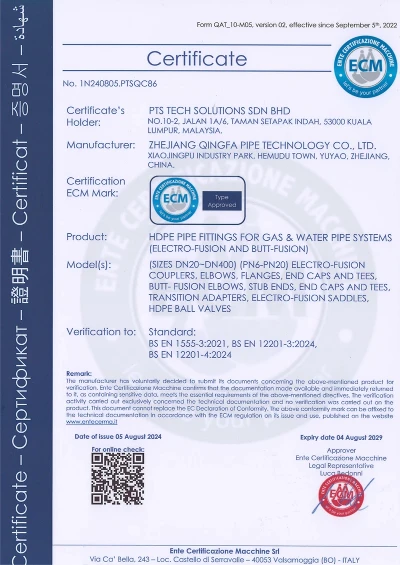
BS EN 1555-3 / EN 12201-3 · DN20–DN400

WRAS approval · PE100 injection moulded

CNAS lab · ISO/IEC 17025:2017
Compliance documents available for this product family
| Document | Number | What it covers | Size range |
|---|---|---|---|
| ECM type approval attestation | 1N241120.ZQPSW72 | HDPE electrofusion fittings to EN 12201-3:2024 / EN 1555-3:2021. Held by Qingfa. The document itself covers products intended for third countries outside the EU market. Valid to November 2029. | DN20 – DN1200 |
| ECM certificate | 1N240805.PTSQC86 | HDPE electrofusion couplers, elbows, flanges, end caps and tees to BS EN 1555-3:2021 / BS EN 12201-3 and -4:2024, with Qingfa named as the manufacturer. Valid to August 2029. | DN20 – DN400 |
| WRAS approval | 251155041 | PE100 black injection-moulded fittings for cold potable water, up to 65 °C. The certificate carries a size schedule - send us your size and we check it against the schedule rather than assume. | Schedule in the certificate |
| In-house laboratory | ISO/IEC 17025:2017 | Accredited testing of fusion joints, dimensional checks and hydrostatic pressure tests, batch by batch. | All sizes produced |
| Third-party test reports | On request | Tensile, hydrostatic and fusion tests from an independent laboratory, for specifications that call for them. | Per batch |
Where the size goes
Two duties take most of the volume at 1400 mm and they are not produced to the same standard, so the medium belongs in the enquiry rather than in a follow-up email. Poly pipe, PE pipe and HDPE pipe are names for the same material; what changes between projects is the standard the fitting is made to.
| Duty | Typical line | Standard the fitting is made to | Note |
|---|---|---|---|
| Gas | City distribution mains, medium and low pressure | ISO 4437 / EN 1555-3 | Gas-grade yellow marking available on request |
| Gas | Transmission tie-ins and district station connections | ISO 4437 / EN 1555-3 | Duty pressure to be confirmed with the order |
| Gas | Biogas, landfill gas and flare collection lines | ISO 4437 / EN 1555-3 | Trace components to be declared before quoting |
| Water | Raw and treated water trunk mains | ISO 4427 / EN 12201-3 | For utility and municipal operators |
| Water | Pump station, reservoir and treatment works connections | ISO 4427 / EN 12201-3 | Chamber dimensions usually drive the section figures |
| Industrial | Process water, effluent and chemical transfer | ISO 4427 / EN 12201-3 | Medium and concentration to be confirmed |
| Industrial | Mining slurry and tailings lines at low pressure | ISO 4427 / EN 12201-3 | Abrasion duty - wall series matters more than pressure here |
Availability: what is standard and what is quoted
| Size | Wall series | Production status | How it is quoted |
|---|---|---|---|
| DN560 – DN1200 | SDR11 and SDR17 | Standard production, moulded in our own presses | From the published range, held against repeat orders |
| DN1400 | SDR17 (PN10) | Tooling finished. Volume output from mid-October 2026 | Against your delivery window, with a date on the quotation |
| DN1400 | SDR11 (PN16) | Subject to confirmation at the time of enquiry | Give the duty pressure and we confirm the fitting first |
| Below DN560 | SDR11, SDR17 | Standard range, DN20 upward | See the full coupler range for the smaller sizes |
Packing and getting an oversized body to site
- Marked before it is packed. Size, wall series and the weld data label stay legible on the body after the pallet has been through a port.
- Strapped, not boxed loose. Carton and pallet specification to your own requirement, including your logo where you supply artwork.
- Paperwork with the goods. Packing list, material certificate and batch test data travel with the shipment so the receiving project is not chasing them a week later.
- Method agreed when the order is placed. A DN1400 body is bulky rather than fragile, so the lifting points, stacking plan and container loading are settled at order stage rather than improvised on the quay.

Finished fittings staged before shipment. Stock items are held against repeat orders; project sizes are scheduled against the delivery date on the order.
Questions that come up before a DN1400 order
Do I need electrofusion at DN1400, or will a butt weld do?
Butt welding is still possible on DN1400, but it needs the pipe to travel along its own axis to close the gap and a hot-plate carriage with room to work. Where the line is already laid, backfilled or anchored at both ends, electrofusion is the method that does not ask the pipe to move: the fitting alone changes shape.
Is DN1400 a production size, or still a development item?
The tooling for this size is finished and production volume starts in mid-October 2026, so it can go into a project schedule now and be quoted against your delivery window rather than held as a prototype.
What are the Ø D, L1 and L figures for DN1400?
They are confirmed from the DN1400 drawing with the enquiry, because the tooling at this size is new. The published charts on this page stop at DN1200, and we will not hand you a scaled-up number to design a chamber around.
Which wall series should I specify at DN1400?
SDR17 (PN10) is the series this page covers and the one produced as standard. If the duty calls for SDR11 (PN16), put the pressure requirement in the enquiry and we confirm availability before you write it into the specification.
Which welding machine will run a DN1400 coupler?
Any compatible electrofusion machine that has the output for a socket this size. The programme is read from the barcode, so the setting is not the issue - the output is. Send us the machine model and we confirm it before the joint is planned.
How long does a DN1400 joint take, including cooling?
Fusion itself is short; the cooling time on the label is the long part and it is set by the wall thickness and the ambient conditions. Plan the joint early enough in the shift that the clamps stay on for the full cooling period, because that period cannot be shortened to make up time.
Will a DN1400 coupler work on natural gas?
The SDR17 range is produced to ISO 4437 and EN 1555-3, which are the gas standards, and gas-grade yellow marking is available on request. Give us the medium and the duty pressure with the enquiry and the quotation names the standard the fitting is made to.
How is a DN1400 order priced and scheduled?
Against the project rather than a stock list - quantity and delivery window move both the price and the production date. One diameter, one series and one date is enough for us to quote, and the date on the quotation comes off our own production plan.
Can the coupler and the packing carry our own brand?
It can. Private label is ordinary work here: the brand mark is cut into the mould, carton and pallet are produced to your artwork, and the documents are issued in the language your customer reads.
The rest of the system, if you are ordering more than the straight: electrofusion elbows, end caps, tees and the wider electrofusion fittings range, with the smaller straight couplers listed separately.
What to send with the enquiry
Six lines are enough for a quotation that can be used rather than queried. Send what you have - the more of this list comes with the first message, the fewer rounds it takes.
Enquiry checklist
| What to send | Why it changes the answer | Example |
|---|---|---|
| Diameter and wall series | Fixes the tooling, the body size and the price band | DN1400, SDR17 |
| Medium and duty pressure | Decides the standard the fitting is produced to | Natural gas, PN10 |
| Quantity and delivery window | Drives the production slot behind the order | 24 pcs, on site by 20 November |
| Document requirement | Tells us which of the certificates above actually applies at your diameter | Material certificate and batch test data |
| Marking and packing | Anything beyond standard is priced and produced to order | Own logo, three units per pallet |
| Site or chamber constraint | If trench or chamber dimensions are already fixed, the drawings can be marked against them | Chamber 2.4 m long, 1.6 m wide |
How to reach us
| Company | Zhejiang Qingfa Pipe Technology Co., Ltd. |
|---|---|
| Works | Hemudu Town, Yuyao, Zhejiang, China Xiaojingpu Industry Park |
| Mob / WhatsApp | +86 15168131515 |
| julie@zjqingfa.com |
Send the list above and the reply carries the price, the production date and the section figures, from the factory that moulds the body rather than from a trading desk.
Every DN1400 PE Electrofusion Coupler - SDR17 PN10, PE100 we ship comes from our own injection lines and is tested in a CNAS-accredited laboratory before despatch. Read about our manufacturing capability.
Hot Tags: DN1400 PE Electrofusion Coupler – SDR17 PN10, PE100, PE100 dn1400 pe electrofusion coupler – sdr17 pn10, pe100, dn1400 pe electrofusion coupler – sdr17 pn10, pe100 supplier, Electrofusion Test End Cap, End Cap HDPE Pipe, HDPE Electrofusion Cap, HDPE End Cap 63mm, HDPE End Plug, HDPE PiPE Cap
You Might Also Like


Send Inquiry