



PE100 SDR to PN Converter: Wall, Mass and Volume
Nov 11, 2026
Leave a message
A polyethylene pipe is specified by four numbers, and any one of them can be derived from the other three: outside diameter, wall thickness, SDR and pressure class. In practice a buyer receives a list that mentions only two of them - "PE100, DN315, SDR17" or "PN16, 110 mm" - and has to fill in the rest before a quotation makes sense. That is what this converter does, and it does it with the arithmetic the standards actually use rather than with a lookup that pretends every size is tabulated.
SDR, wall thickness and pressure class
Type the outside diameter, pick how the pipe is described, and the rest follows.
Two of the six boxes deserve a warning. The wall thickness is the nominal value, not the measured one: a pipe is allowed to sit within a tolerance band, and the tolerance widens as the size grows, so a DN315 SDR17 pipe with a nominal 18.7 mm wall can legitimately measure a good deal less. And the pressure class is not a rating for every fluid at every temperature. It is a figure calculated for water at 20 degrees C with a design coefficient of 1.25, which is why the same SDR gives a much lower number in gas service, where the coefficient is 2.0.
SDR is a ratio, which is why it repeats across sizes
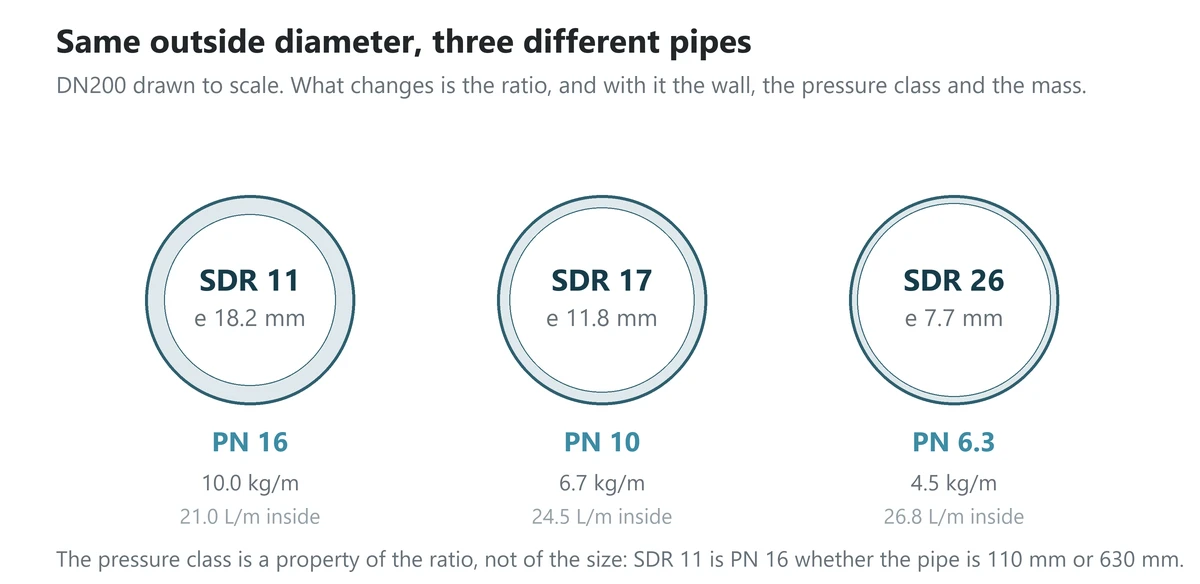
SDR stands for standard dimension ratio, and it is simply the outside diameter divided by the wall thickness. A DN110 pipe with a 10 mm wall is SDR 11. A DN315 pipe with a 28.6 mm wall is also SDR 11, and so is a DN630 pipe with a 57.2 mm wall. All three carry the same pressure class, because pressure capacity depends on the ratio and not on the absolute size - a bigger pipe of the same SDR has a proportionally thicker wall and correspondingly more hoop stress to resist.
What changes with size is stiffness. Two pipes can share SDR 11 and PN 16 and behave completely differently when buried: the small one deflects under a loader, the large one does not. That is the reason specification sheets pair a pressure class with an installation condition, and the reason a project that only specifies PN is under-specified.
Where the pressure class comes from
The calculation is short enough to check by hand. The allowable stress is the material's minimum required strength divided by the design coefficient, and the pressure class is that allowable stress multiplied by two, divided by SDR minus one. For PE100 the minimum required strength is 10 MPa, so water service gives an allowable stress of 8 MPa and a pressure class of 16 divided by (SDR - 1) in bar. SDR 11 returns exactly 16 bar. SDR 17 returns 10 bar. SDR 26 returns 6.4 bar, which is declared as PN 6.3 because the class series stops there and a pipe is never rounded up.
The last point is worth holding on to: the calculated figure and the declared class are not always identical, and the declared class is always the lower of the two. SDR 13.6 calculates to 12.7 bar and is declared PN 12.5. SDR 26 calculates to 6.4 and is declared PN 6.3. Anyone who takes the arithmetic as the rating and then adds a surge allowance on top has added it twice.
| SDR | Calculated PN, water | Declared class | Calculated PN, gas | Typical use |
|---|---|---|---|---|
| 41 | 4.0 bar | PN 4 | 2.5 bar | Gravity sewers, low-head outfalls |
| 33 | 5.0 bar | PN 5 | 3.1 bar | Irrigation mains, low-pressure transfer |
| 26 | 6.4 bar | PN 6.3 | 4.0 bar | Gravity and low-pressure water |
| 21 | 8.0 bar | PN 8 | 5.0 bar | Rural distribution |
| 17 | 10.0 bar | PN 10 | 6.3 bar | The default for municipal water |
| 13.6 | 12.7 bar | PN 12.5 | 7.9 bar | Higher-pressure distribution |
| 11 | 16.0 bar | PN 16 | 10.0 bar | Trunk mains, gas distribution |
| 9 | 20.0 bar | PN 20 | 12.5 bar | Pumped rising mains |
| 7.4 | 25.0 bar | PN 25 | 15.6 bar | Industrial and high-head lines |
The wall printed in the standard is thicker than the division
Divide 315 by 17 and the answer is 18.53 mm. The pipe in the standard table has an 18.7 mm wall. Nothing is wrong: the dimensional tables round the wall up to the next preferred value, which pushes the actual SDR slightly below the nominal one and the pressure class slightly above. The effect is small - a fraction of a bar - but it matters when a buyer checks a delivered pipe against a calculation rather than against the standard, and it matters more at the large sizes where the rounding step is coarser.
This is also why the converter shows the wall to one decimal and labels it nominal. For a delivered pipe, the figure to check is not the nominal wall but the wall at the point of measurement, compared against the tolerance in the standard for that size. A pipe that measures under the tolerance is out of specification whatever the arithmetic says.
Mass and volume, which is what the order is really made of
The mass per metre in the converter is the section area multiplied by the density of the compound - about 0.959 for PE100 and 0.955 for PE80 - and it is the number that turns a project into a shipment. A DN315 SDR17 pipe weighs about 16.5 kg per metre, so a 500-metre order is eight tonnes before a single fitting is added, and the container loading calculator will tell you that five tonnes of pipe is a volume problem rather than a weight problem.
The internal volume is the other half of the same arithmetic: it decides flushing volumes, the cost of the water that fills the line, and whether a gravity sewer can carry the design flow at the intended gradient. Both figures come from the same two inputs, which is why they are in the same tool.
| dn (mm) | e at SDR 11 (mm) | Mass, SDR 11 (kg/m) | e at SDR 17 (mm) | Mass, SDR 17 (kg/m) |
|---|---|---|---|---|
| 63 | 5.7 | 1.0 | 3.7 | 0.7 |
| 110 | 10.0 | 3.0 | 6.5 | 2.0 |
| 160 | 14.5 | 6.4 | 9.4 | 4.3 |
| 200 | 18.2 | 10.0 | 11.8 | 6.7 |
| 315 | 28.6 | 24.7 | 18.5 | 16.5 |
| 400 | 36.4 | 39.9 | 23.5 | 26.7 |
| 630 | 57.3 | 98.9 | 37.1 | 66.3 |
Wall and mass above are dn divided by SDR, so a few values sit fractionally below the tabulated wall in the standard, which rounds up to the next preferred figure.
The mass column is the reason a PE100 SDR17 pipe is often the cheapest way to move water: at DN315 it carries PN 10 with 16.6 kg per metre, against 24.8 kg for the SDR 11 alternative. Two thirds of the material for the same pressure class, and a correspondingly smaller crane and lighter trench loads.
What the converter does not know
Three things sit outside the arithmetic and all three can invalidate a selection. The first is temperature: the pressure class is calculated at 20 degrees C, and continuous service above that reduces it - about 1.3 per cent per degree for PE100, so a line running at 40 degrees C has roughly three quarters of PN 16 to work with. The second is the fluid, since hydrocarbons and strong oxidisers attack the polymer regardless of its pressure class. The third is the nature of the load: a pressure class says nothing about resistance to point loading, cyclic surge or soil movement, and the crack-resistant grades sold as PE100-RC exist precisely because those are the cases where a standard compound is not enough.
For the dimensional and marking side of the same question, the specification tables list the values size by size, and the standards comparison sets out where ISO 4427, EN 12201 and the national texts disagree. Fittings matched to these pipes are covered under SDR11 HDPE fittings and electrofusion fittings, and the jointing parameters for the pipe ends are in the butt fusion parameter tables.
Send Inquiry