



PE Pipe and Fitting Standards: Six Systems, One Arithmetic
Nov 11, 2026
Leave a message
Two PE100 fittings can leave two factories with the same outside diameter, the same wall thickness, the same resin grade and the same hydrostatic test result, and one of them will be rejected by a buyer's engineer while the other is accepted. Nothing about the parts explains it. What differs is the document pack each factory can produce, and that is decided by which standard the parts were made to.
That is why standards are worth understanding as a purchasing tool rather than a compliance formality. A standard does not describe a better or worse fitting. It fixes the arithmetic, the test list and the paperwork, and those three things are what a tender is actually comparing when it names a standard number.
A standard answers three questions, and buyers usually only ask about one
Every PE piping standard, in every market, is built from the same three layers. The names change and the annexes change, but the structure does not.
| Layer | The question it settles | Where it lives in the standard |
|---|---|---|
| Material | What the resin has to be capable of over 50 years at 20 degrees C | Material classification by MRS, cross-referenced to the creep rupture extrapolation and the compound's test data |
| Geometry | What the outside diameter, wall thickness and tolerances are, and how SDR and PN relate | Dimensional tables and the pressure derating arithmetic |
| Evidence | Which tests prove the first two, on how many samples, and what the marking must say | Type tests, batch tests, marking and the declaration of conformity |
Buyers ask about the second layer, because it is the only one visible on a drawing. The first and third are where suppliers differ, and where a quotation can look identical and be worth something different. A fitting made from a certified PE100 compound and type-tested to the standard is not the same commercial object as a fitting made from an unclassified compound that measures correctly.
One root, several national branches
Almost every metric PE water standard in use descends from the ISO 4427 family, which is published in parts: general, pipes, fittings, valves, and fitness for purpose. National standards then either adopt it, adopt it with a national annex, or write a parallel document with the same technical basis.

| Market | Water | Gas | What it actually adds |
|---|---|---|---|
| International | ISO 4427, parts 1 to 5 | ISO 4437 | The reference arithmetic and test list that the others follow |
| Europe | EN 12201, parts 1 to 5 | EN 1555 | Harmonised European text, national annexes, CE marking route |
| Australia, New Zealand | AS/NZS 4130 pipes, AS/NZS 4129 fittings | Covered within the same pressure-pipe family | Regional compounds and colour requirements |
| China | GB/T 13663 | GB 15558.1 pipes, GB 15558.2 fittings | National dimensional tables, marking rules, domestic certification |
| India | IS 4984 | Separate gas series | National sizing practice and inspection convention |
| South Africa | SANS 4427 | Separate gas series | Adoption of ISO 4427 with local marking requirements |
The practical consequence is narrower than it looks. Because the branches share a technical basis, a fitting that is genuinely correct to one of them is usually correct to the others in everything except the paper. What you cannot do is assume the paper transfers. A certificate to GB/T 13663 is not a certificate to EN 12201, and a buyer working under a European tender is entitled to say so.
The inch-based systems used in North America sit outside this family. They use the same physical ratio between diameter and wall, but a different design factor and a psi pressure class, so a metric PN value cannot be read across to a psi class even at an identical ratio.
Water and gas are two separate families, not two applications of one
This is the distinction that most often gets lost in a translation. Water and gas are governed by different standard families, and the difference is not cosmetic.
Each family sets its own design coefficient. For water, the coefficient is typically 1.25; for gas it is typically 2.0 or higher. The fitting in your hand does not change. The wall thickness required to reach a given pressure does.

A PE100 fitting at SDR 11 is a PN 16 item in a water system and approximately a PN 10 item in a gas system, because the same wall is being asked to carry a larger safety margin. This is why a gas order specifies thicker walls for the same pressure, and why quoting a water fitting into a gas enquiry with the same SDR and the same PN is a technical error rather than a commercial one.
Fittings do not inherit the pipe standard by default
ISO 4427 is written in parts, and the part numbers matter. Part 2 is pipes. Part 3 is fittings. A supplier that claims "ISO 4427" without a part number is making a claim that a technical reviewer cannot check, and a reviewer who cannot check it will usually discount it.
The same structure repeats in the national branches: EN 12201-3 for fittings, AS/NZS 4129 for fittings in the Australian system, GB 15558.2 for gas fittings in China. The reason fittings get their own part is that they fail differently. A pipe is a homogeneous wall in tension; a fitting is a moulded shape with a weld line, a stress concentration at every change of section, and, in the electrofusion case, an embedded heating element and a socket fit that depends on the pipe's ovality. On the pipe side the equivalent size tables by family are where the dimensional questions usually start.
So the type test list is not the same. Fittings are tested for internal pressure as assemblies, and the fusion joint itself is usually qualified separately, because the joint is where service failures concentrate.
The SDR arithmetic is identical in every one of them
This is the part that repays a few minutes, because it turns a table into a calculation you can check.
The pressure rating is derived from the material's minimum required strength, divided by a design coefficient, and converted through the wall ratio. In metric form, with MRS in megapascals and PN in bar:
PN = 20 x MRS / (C x (SDR - 1))
For PE100, MRS is 10 MPa. For water, C is 1.25, which reduces to 160 / (SDR - 1). For gas, C of 2.0 reduces to 100 / (SDR - 1). Every entry in the table below follows from those two expressions, and any supplier's catalogue entry that does not can be checked in seconds.
| SDR | Calculated PN, water (C = 1.25) | Declared PN, water | Calculated PN, gas (C = 2.0) |
|---|---|---|---|
| 41 | 4.0 | PN 4 | 2.5 |
| 33 | 5.0 | PN 5 | 3.1 |
| 26 | 6.4 | PN 6.3 | 4.0 |
| 21 | 8.0 | PN 8 | 5.0 |
| 17 | 10.0 | PN 10 | 6.3 |
| 13.6 | 12.7 | PN 12.5 | 7.9 |
| 11 | 16.0 | PN 16 | 10.0 |
| 9 | 20.0 | PN 20 | 12.5 |
| 7.4 | 25.0 | PN 25 | 15.6 |
For a single-family view of the same arithmetic, the SDR11 range sets out one wall ratio across every fitting type. The declared water values are rounded down to the preferred series, which is why SDR 26 appears as PN 6.3 rather than 6.4. The gas column is not a catalogue series; it is what the same arithmetic produces when the design coefficient changes, and it explains the wall thickness difference between a water and a gas order without any appeal to different manufacturing.
Welding is a third axis, and it is not covered by the product standard
A fitting that conforms to a product standard has been shown to be capable of holding pressure. It has not been shown that the joint in the ground was made correctly. That is a separate qualification and it is documented separately.
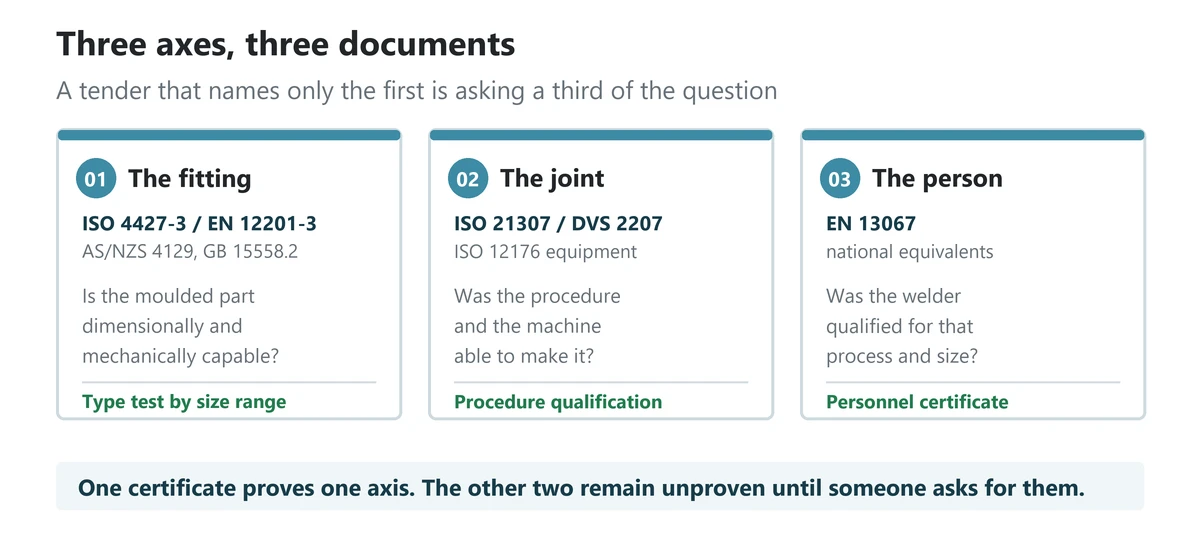
Three axes, three documents. The product standard covers the fitting. The jointing standard covers the procedure and the equipment. The personnel standard covers the welder. A tender that names only the first is incomplete, and a supplier that offers only the first is answering an easier question than the one being asked.
For butt fusion the reference documents are the ISO 21307 procedure family and the DVS 2207 series, with ISO 12176 covering the equipment. For electrofusion, the fitting manufacturer's own fusion programme is part of the qualified procedure, because the parameters are written into the fitting rather than derived on site. Welder qualification runs on its own track, EN 13067 in Europe and national equivalents elsewhere; the scope of a welder qualification is narrower than most crews assume.
What a moulder has to hand over
Conformity is not a claim, it is a document set. In practice a buyer should be able to ask for five things and receive all of them.
- Type test reports to the named standard and part, on the fitting family and the size range, from a laboratory that is identified. Internal pressure tests at 20, 80 and 95 degrees C, slow crack growth resistance by notch test, oxidation induction time, and melt flow rate on the compound.
- The compound certificate, naming the grade and the batch, traceable to the resin producer.
- Batch records linking production lots to test lots, so that a delivered carton can be traced to a specific test.
- Dimensional records for the sizes shipped, not for the family as a whole.
- A declaration of conformity that names the standard, the part number and the size range, signed and dated. Where the goods are exported, the same document is what a broker attaches to the customs classification.
Third-party inspection by a recognised body is not required by every standard, and it is the fastest way to close the gap when the buyer's own engineering team cannot visit. Where it is offered, the scope matters more than the logo: a report on a different size or a different fusion system proves very little about the carton in front of you.
Where tenders diverge in practice
Three differences show up repeatedly once the standard number is agreed.
The first is the national annex. A European tender may cite EN 12201 and then add a national requirement that changes a tolerance or a marking rule. The annex is part of the standard, so a supplier who quoted from the main text alone is not yet compliant.
The second is potable water approval. A product standard covers strength and dimensions, not toxicology. Drinking water contact approval is a separate scheme administered nationally, and it is specific to the fitting model and the material formulation, not to the factory. This is the requirement that most often arrives late in a European or Gulf tender and cannot be met retroactively.
The third is marking. What has to be printed on the fitting, in which language, and at what minimum size, varies by market and is checked at goods-in by inspectors who know exactly what to look for. A fitting that is technically correct and marked to the wrong convention is a rejected delivery.
Frequently asked questions
Is ISO 4427 the same as EN 12201?
They share a technical basis and are not interchangeable documents. EN 12201 is the European standard for PE water systems and follows the same structure, with European test methods and a CE marking route. A supplier holding EN 12201 test evidence can usually support an ISO 4427 claim with the same data, but the certificate has to name the standard it was issued against.
Which standard applies to the fittings rather than the pipe?
Part 3 of the same family, for example ISO 4427-3 or EN 12201-3, and in the Australian system AS/NZS 4129. Fittings are specified separately because they have their own failure modes and their own test list. A claim of conformity to a pipe standard says nothing specific about a fitting.
Why is a gas fitting thicker than a water fitting at the same pressure?
Because the design coefficient is higher. Water systems typically use 1.25 and gas systems 2.0 or more, so the same pressure rating requires a lower SDR and therefore a thicker wall. The arithmetic is PN = 20 x MRS / (C x (SDR - 1)), and the only variable that changed is C.
Can an ISO 4427 certificate be used for a GB/T 13663 order?
As supporting evidence, yes; as the certificate of conformity, no. The test data will usually be relevant because the technical basis is shared, but the declaration has to name the standard the buyer specified. Most experienced buyers will accept the data and ask for the declaration to be reissued, which is a paperwork exercise rather than a retest.
Is a welder certificate part of the product standard?
No. Product conformity, jointing procedure and personnel qualification are three separate documents under three separate standards. A fitting that meets ISO 4427-3 and a crew with no qualification can still produce a pipeline that fails, and the paperwork will look complete if only the first document is requested.
What is the fastest way to check a supplier's conformity claim?
Ask for the type test report by size range and read the standard number and the part number in its header, then compare the sizes tested with the sizes you are buying. A report that is genuine but covers a different size range or a different fusion system answers a question you did not ask.
Working the numbers the standards define
The standards above settle what has to be proved; three tools on this site do the arithmetic that follows from them. The SDR to PN converter turns an outside diameter and a ratio into a wall thickness, a pressure class and a mass per metre, and works backwards from a measured wall. The butt fusion parameter tables give the times that belong to that wall thickness and the force the carriage has to hold. The container loading calculator then converts a finished order into cartons, tonnes and cubic metres, which is where most quotations stop being accurate.
Send Inquiry