



HDPE Welder Qualification and Operator Training for Butt Fusion and Electrofusion
Nov 09, 2026
Leave a message
Two crews, one machine, one coil of PE100 dn315, one day. The first crew's joints pass the bend test at every sampling point. The second crew's joints pass the bead gauge, pass the pressure test, and one of them separates at the fusion plane fourteen months later, when the trench is closed and the road is open again. Nothing in the machine log explains the difference, because the machine did the same thing both times.
What differed was the set of decisions the machine does not make: how deep the pipe was planed, how long the heater was out before the pipe went in, whether the clamps came off at the end of the cooling time or at the end of the coffee break. Qualification exists to control those decisions. Most projects buy it as a certificate and never check what the certificate covered, which is why the same projects are surprised by the failures.
This page is about the qualification system rather than about welding technique: what the test proves, what the scope of a certificate really covers, how to build a programme that produces judgement instead of reflexes, and how to check a subcontractor crew in one afternoon. For the jointing methods themselves, see butt fusion and electrofusion compared.
The machine is the constant, the operator is the variable
A modern fusion machine holds the heater plate within a few degrees, keeps the pressure within a bar and counts the seconds. Take twenty joints from the same machine on the same day and the machine-side parameters are effectively identical. The spread in joint quality comes from six decisions taken by hand.

Changeover time is the one that fails silently. It is measured in seconds, it is taught once during training, and it is the first thing a crew shortens when the wind picks up or the trench starts filling. A joint made with a twenty-second changeover instead of the eight seconds in the procedure still produces a bead. It still passes the bead gauge. It fails at the fusion plane months later, and the record explains nothing because nobody wrote the changeover down.
The same logic applies to scraping. An electrofusion coupler is unforgiving in a way that butt fusion is not: the oxide layer has to come off to a stated depth over the full insertion length, and a scraper that skips the top of the pipe leaves a strip that no amount of pressure will bond. The parameter tables are in butt fusion parameters for HDPE pipe; the point here is that knowing the table and following the table are different competences.
What a qualification test actually proves
The European route is EN 13067, the qualification testing of plastics welders. The German-language route for heated tool butt welding of PE pipe is DVS 2212-1. National gas and water schemes build on one or the other, and most client specifications in the Gulf and in Southeast Asia reference EN 13067 directly. A project that runs to ISO 21307 still needs a welder scheme from outside that document, and the split between the two families is set out in DVS 2207 vs ISO 21307.
The test itself is unglamorous. The candidate produces test pieces on the process and the diameter range being certified, working to the written procedure, under observation. The pieces are then destroyed: a bend test to EN 12814-1 and a tensile test to ISO 13953 for butt fusion, a peel test to ISO 13954 or ISO 13955 for electrofusion. A pass means the operator can read a procedure, run the sequence in the right order and at the right timing, and produce an interface that reaches the specified mechanical values.
That is a real and useful thing to know. It is also narrower than most people assume, because the test is supervised. A supervisor standing at the machine removes exactly the behaviours that cause field failures: nobody lets a candidate skip a facing pass, wipe the pipe with a damp cloth, or take the clamps off early. The certificate therefore proves capability under supervision. Field quality is capability without supervision. The gap between the two is where almost every defect on this site is born.
Two consequences follow. A certificate is a floor and not a guarantee. And the things the test cannot measure - defect recognition, and honesty about what went into the log - have to be trained and audited separately, because no test piece can report them.
The scope of a certificate: four dimensions nobody reads
A certificate is not a licence to weld polyethylene. It is a licence to weld one process, in one material group, within one diameter range, at one range of wall thickness. Four dimensions, plus a fifth that is usually the only one anybody looks at: the date.
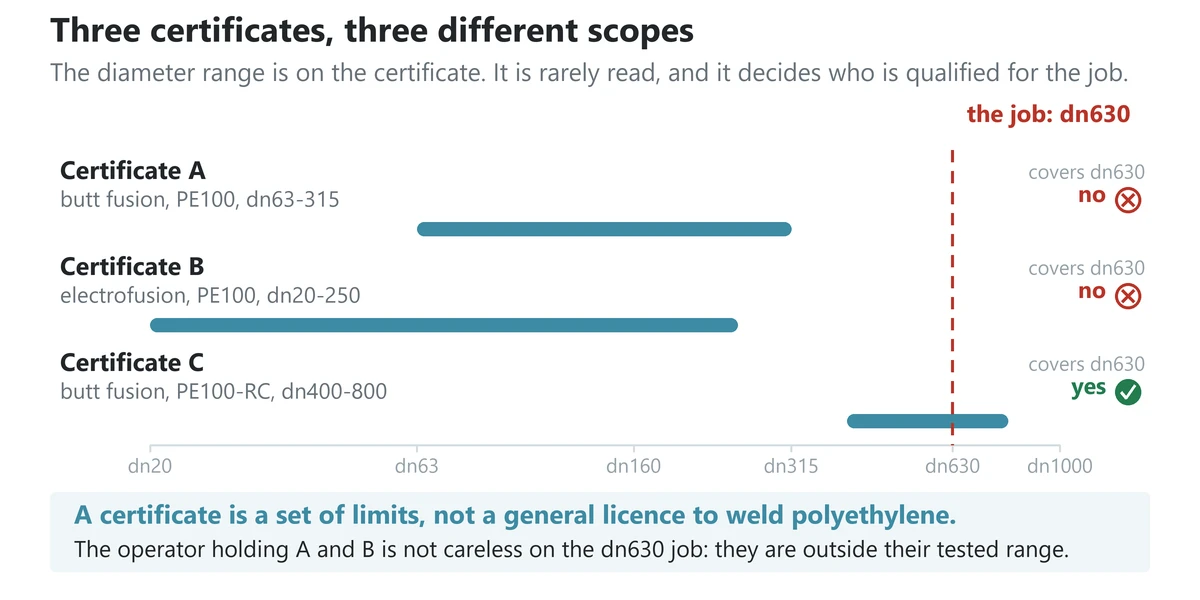
Diameter range causes the most damage in practice. An operator certified on dn63-315 who is handed a dn800 machine has not been qualified for that work. Aligning a 90 kg fitting against a pipe on a slope, with a heating plate that weighs more than the fittings on the smaller machine, is a different physical job from aligning 4 kg parts on a bench. The certificate does not say so, and the crew will not volunteer it.
Process is the second. Butt fusion and electrofusion share the material and almost nothing else: scraping depth and coverage, insertion depth, the order in which the terminals are connected, reading a control unit that can abort a cycle half way, and a joint that is invisible once the coupler is on. See electrofusion versus butt fusion for where the two diverge on site. A butt fusion certificate does not carry over, and an operator who is excellent at one is a trainee on the other.
Wall thickness is the third, and it is the one that hides inside the diameter range. A procedure qualified at SDR17 is not valid at SDR11 on the same outside diameter, because heating time, changeover time and cooling time all scale with wall thickness - and so does the consequence of getting them wrong. A thick wall holds heat longer and cools slower; a thin wall is far less tolerant of an over-long changeover.
Material group is the fourth: PE80, PE100, PE100-RC. They weld with the same equipment and behave differently at the interface, which is why every qualification scheme treats them as separate groups rather than as one material called polyethylene.
| Dimension | What the certificate has to state | What happens when it is missing |
|---|---|---|
| Process | Butt fusion, electrofusion, or socket fusion, named separately | An operator is asked to run a process they were never tested on, and says yes |
| Material group | PE80, PE100 or PE100-RC | A procedure qualified on one grade is applied to a different melt behaviour |
| Outside diameter | A range such as dn63-315, not the word HDPE | A dn800 joint is made by someone qualified to dn315 |
| Wall thickness | The SDR range covered by the procedure | Heating and cooling times are applied outside the range they were validated for |
| Issuer and dates | Independent body, issue date, expiry date | A document is accepted that nobody can verify, or that expired two years ago |
A syllabus that produces welders, not button operators
Seven modules, and each one ends in a behavioural test rather than a verbal one. The operator has to demonstrate the thing, not describe it. Anything that can be passed by talking can be passed by an operator who will not do it at seven in the morning in the rain.
- Material basics. PE80 against PE100, what melt flow rate changes at the interface, why the same pipe from two suppliers can weld differently, and what oxidation does to a surface. Test: explain why a scraped surface has to be welded inside the stated time, and what happens if it is not.
- Equipment and pre-shift checks. Heater plate temperature measured with an external probe rather than the display, pressure gauge zero, ram travel, facing tool condition, generator capacity. Test: find three faults that the trainer has introduced into a machine.
- Pipe preparation. Facing to a continuous chip, alignment and gap check, scraping depth and full coverage for electrofusion, cleaning and marking. Test: prepare two joints, one of which the trainer has contaminated without saying so.
- Parameter control. Reading the procedure table, changeover discipline, pressure and hold, cooling time and what is allowed after it. Test: run a full cycle with a stopwatch held by somebody else.
- Defect recognition. A bead atlas and a cut-out atlas - cold weld, over-fusion, contamination, misalignment, ovality - seen from outside and seen in section. Test: judge ten joints, five of them rejects, and say what produced each one.
- Destructive testing. How bend, tensile and peel specimens are cut, what a good failure looks like and what a bad one looks like. Test: the operator cuts and tests their own qualification joints and reads the result without help.
- Recording. The joint log, the parameters that must be written at the machine, and what a traceable record contains on a gas main. Test: complete a log from a machine printout in which one parameter has been left out.
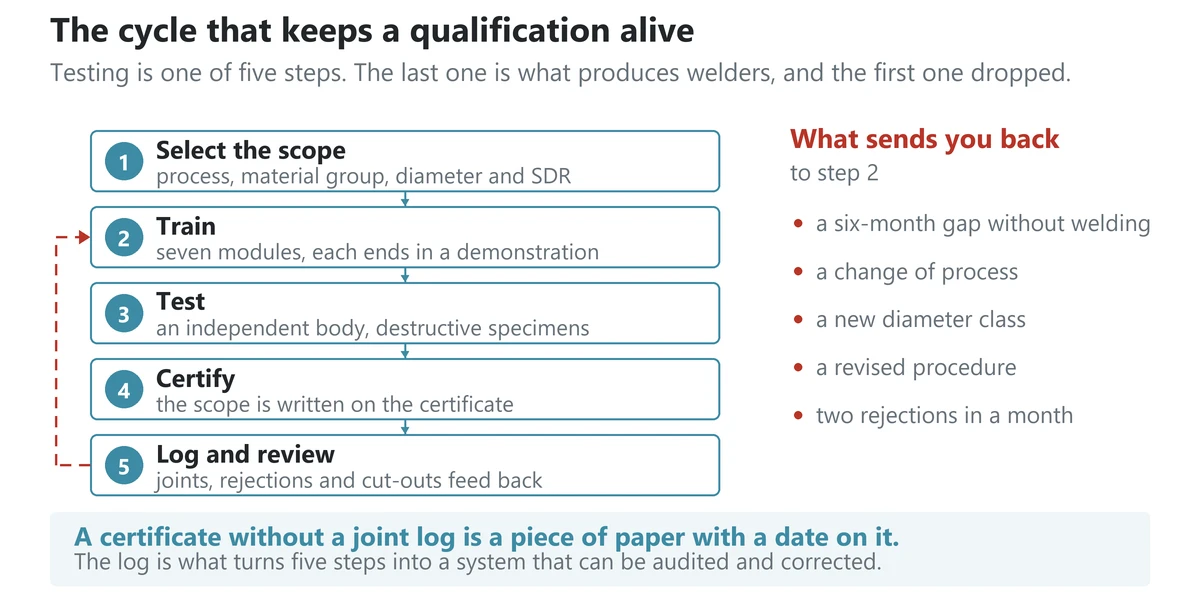
The last module is the one training programmes skip, and the one that survives an audit. An operator who has written down a thousand joints understands what matters in a record. An operator who has never written one treats the log as paperwork to be completed from memory at the end of the shift, which is also the moment when the forty seconds of changeover becomes eight seconds in the retelling.
Where training programmes fail
- Teaching the sequence instead of the reason. An operator who knows why changeover matters will not shorten it when the trench is wet. An operator who has memorised a number will shorten it the moment the number is inconvenient.
- No defect atlas. If the only joint an operator has ever examined closely is the one in front of them, they will accept a bead that a trained eye rejects, because they have never seen the reject standing next to the accept.
- No destructive feedback. A crew that never sees one of its own joints fail a bend test never calibrates its eye. The single most effective training hour is a cut-out of your own work, opened in front of the people who made it.
- No adverse-condition training. Cold, wind, direct sun, dust and rain each change a parameter or a handling rule, and almost all training happens in a workshop at twenty degrees. See electrofusion in cold weather for how far the limits move.
- Buying the certificate instead of the capability. If the only requirement is a piece of paper by Friday, the market will supply a piece of paper by Friday. The defence is to specify the scheme, the scope and the test report, not the document.
The feedback loop is usually missing as well: refresher training happens after a failure rather than before it. A crew with a three per cent reject rate has a training need that is visible today. A crew with a zero per cent reject rate and one cut-out a year has a blind spot that no statistic will reveal.
Re-certification, lapse and the long gap
Qualification is not permanent. Most schemes issue it for about two years and add a lapse rule: if the operator has not welded the process for six months or more, the qualification is suspended until a re-test. The reasoning is that competence decays faster than the certificate does, and a certificate cannot distinguish an operator who welded four thousand joints last year from one who spent the year on a different job.
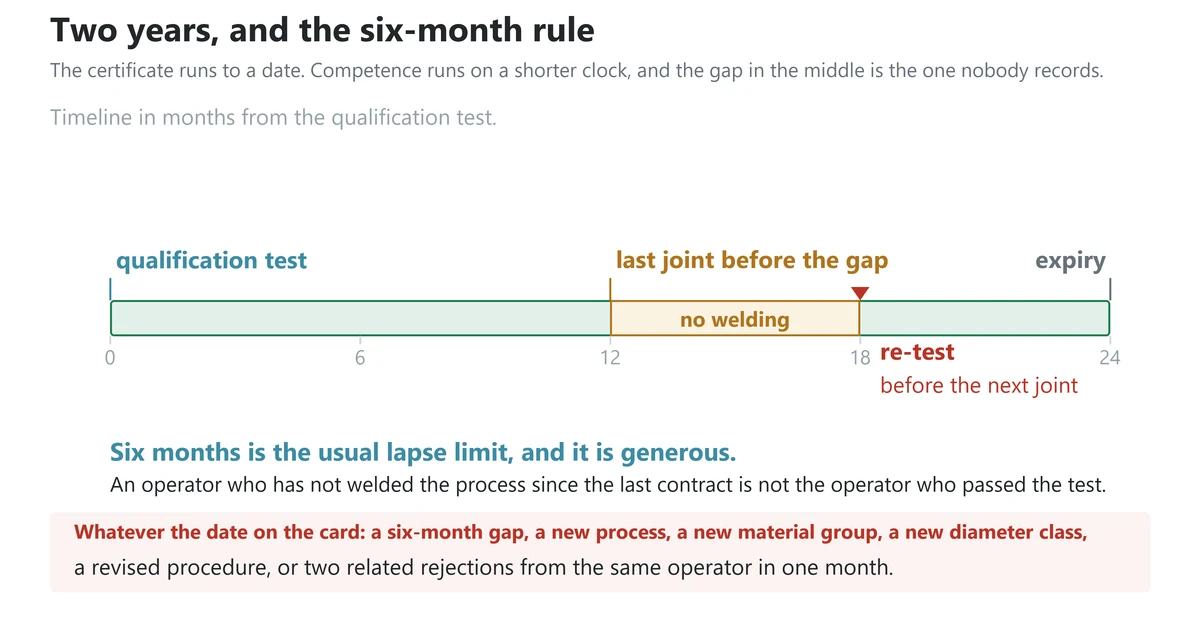
Beyond the calendar, six events should force a re-test whatever the expiry date says: a lapse of six months; a change of process in either direction; a new material group; a diameter class beyond the certified range; a revision to the welding procedure; and two or more related joint rejections from the same operator within a month. The last one is the useful one, because it is the only trigger that fires on evidence rather than on administration.
Qualifying a crew you did not train
Most construction work is subcontracted, so in practice you are not auditing a training programme, you are auditing somebody else's output. Four documents and one joint will tell you more than a day of interviews:
- The certificate, read for scope. Process, material group, diameter range, wall thickness, issuing body, expiry. A certificate that does not state a diameter range has not been read properly by anyone, including the crew carrying it.
- The test report behind it. The certificate says a test happened. The report says when, on what dimensions, and with what results. Ask for both, and ask which of the two the office actually filed.
- Machine calibration records. A qualified operator on an uncalibrated machine produces unqualified joints. The four tests for a used butt fusion machine describe what a calibration record should be able to show.
- A list of joints welded in the last six months. Dates, diameters, locations. This is where the lapse rule catches most crews, and it costs nothing to ask.
- One supervised trial joint, cut out and bend tested on the first day. The cheapest filter in the project: one joint and two hours, against a cut-out in a live main eighteen months later.
The trial joint does something the documents cannot. It shows how the crew behaves when somebody is watching and the result matters. Operators who narrate what they are doing, call out the changeover, and check the gap with a gauge before the heater goes in are usually the same operators who do it when nobody is watching - but on the first day you cannot tell, and a cut-out settles the question.
Records that survive an audit
On a gas main a joint without a record is treated as a suspect joint, and it is the log that turns a weld into an asset. The record has to be written at the machine as the joint is made. A log completed at the end of the shift from memory is a document about the operator's confidence, not about the joint, and an inspector who has seen both can tell them apart in about four seconds.
| Field | Why it matters | Who checks it |
|---|---|---|
| Operator ID and qualification number | Links the joint to a scope and to a date | Client inspector, at audit |
| Machine ID and calibration due date | Separates operator error from equipment error | QC, weekly |
| Material batch and supplier | The only traceability if a resin-related failure appears | Client inspector |
| Diameter, SDR and ambient temperature | Tells a reviewer which parameter table should have been used | QC, daily |
| Heater temperature, pressure, times, changeover | The only evidence that the procedure was followed rather than remembered | Inspector, on the day |
| Cooling time and time of release | Separates a cracked bead from a load applied too early | Failure investigation |
A useful cross-check is to compare a month of logs against the bead photographs and the machine printouts. Where the three disagree, the log is almost always the optimistic one. The construction sequence and quality control system in HDPE butt fusion fittings: construction sequence shows where the log entry sits in the joint cycle, and finding the cause before you re-weld shows what the record is for when something goes wrong.
What to write in the specification
Most specifications say that the welder must be certified. That is not a requirement, it is a wish, because it names no scheme, no scope and no evidence. A requirement that can be checked reads more like this:
All fusion operators shall hold a current qualification to EN 13067, or to a national scheme recognised as equivalent, issued by an independent body. The certificate scope shall state the process, the material group, the outside diameter range and the SDR range, and shall cover the largest diameter and the thinnest wall to be welded on this contract. Qualifications shall be re-validated after any lapse of six months or more. Each crew shall make one trial joint on its first day of work, which shall be cut out and bend tested to EN 12814-1 at the contractor's cost. Joint logs shall be submitted with the daily report.
The last sentence is the one that changes behaviour, because it makes the log part of the deliverable rather than an internal convenience. Everything before it only makes the log possible.
Frequently asked questions
How long does an HDPE welder qualification last?
About two years under most schemes, with a lapse rule that suspends the qualification if the operator has not welded the process for six months or more. The date on the certificate and the operator's recent experience are two different pieces of information, and the second one is what matters in a trench.
Does a butt fusion certificate cover electrofusion work?
No. They are separate qualifications because they test different skills: alignment and changeover discipline on one side, scraping, insertion depth and control-unit operation on the other. An operator who is excellent at butt fusion is a trainee again on an electrofusion coupler, and the failures look different too - see the twelve electrofusion failures.
Can a contractor certify its own welders?
In-house training is normal and useful; in-house certification is not. The value of the certificate comes from the independence of the test rather than from the test itself. The workable arrangement is in-house training plus an external test house, so that training can be tailored to your procedures while the evidence stays independent.
How many test pieces does a qualification need?
Enough to cover every combination in scope, which usually means one set per process, material group and diameter class, with a bend and a tensile specimen for butt fusion and a peel specimen for electrofusion. The exact count comes from the scheme being worked to. What matters at the end is that the scope of the certificate matches the work, not that a larger number of pieces was tested.
What happens if an operator fails a re-test?
The qualification lapses and the operator stops welding until it is regained. A first failure is usually a training signal rather than a disciplinary one: check whether the operator was working to a superseded procedure, or on a machine type they had not used before. Re-test after remediation and record the failure, because failures repeated across a crew point at the procedure or the equipment rather than at the individual.
Related reading
- Cold weld in HDPE butt fusion - the defect that a shortened changeover produces, and how to prove it exists.
- NDT inspection of HDPE welds - what can still be checked after the operator has gone home.
- HDPE pipe fitting defects: finding the cause before you re-weld - the symptom-to-parameter map this page sits under.
- Why electrofusion joints fail: the three root causes - contamination, geometry and early release, all of them operator decisions.
- Pipe scraping before electrofusion - the single preparation step most often done too shallow.
- Electrofusion welding procedure: five steps that hold pressure - the sequence an operator is being qualified against.
- Welding PE pipe in rain, heat and cold - what changes when training conditions and site conditions diverge.
Send Inquiry