



Material Mismatch in PE Pipe Welding: Mixed Grades and MFR
Nov 09, 2026
Leave a message
Two pipe ends can be round, square, clean, aligned and welded at exactly the right temperature, and still produce a joint that separates along a flat plane years later. The reason is in the material, and it is the one variable in butt fusion that the welding machine cannot see.
Material mismatch is not a handling error and it is not a parameter error. It is a decision made upstream - at the depot, at the specification stage, or in the trench when the last length of PE100 runs out and a length of something else is close at hand. This page covers what actually has to match, where the mismatches come from, which ones can be welded at a lower rating, and which ones cannot be welded at all.
Why two polyethylenes do not necessarily fuse well
Butt fusion works because molten polyethylene chains diffuse across the interface and entangle before the joint cools. That mechanism assumes something that is easy to overlook: the material on both sides has to reach a similar state at the same moment, under the same pressure, and then solidify in a similar way.
If the two sides melt to different viscosities, one flows and the other does not. If they crystallise at different temperatures, one has already stiffened while the other is still mobile. If their additive packages age at different rates, the interface becomes the weakest zone in the wall long after everything looked fine. None of these failures is visible on the bead, and none of them is detected by a hydrostatic test. The process that produces a sound interface in the first place is set out in the PE pipe fusion welding guide.
The three properties that have to be close
Polyethylene is described by a short set of numbers, and three of them determine whether two materials will weld well together.
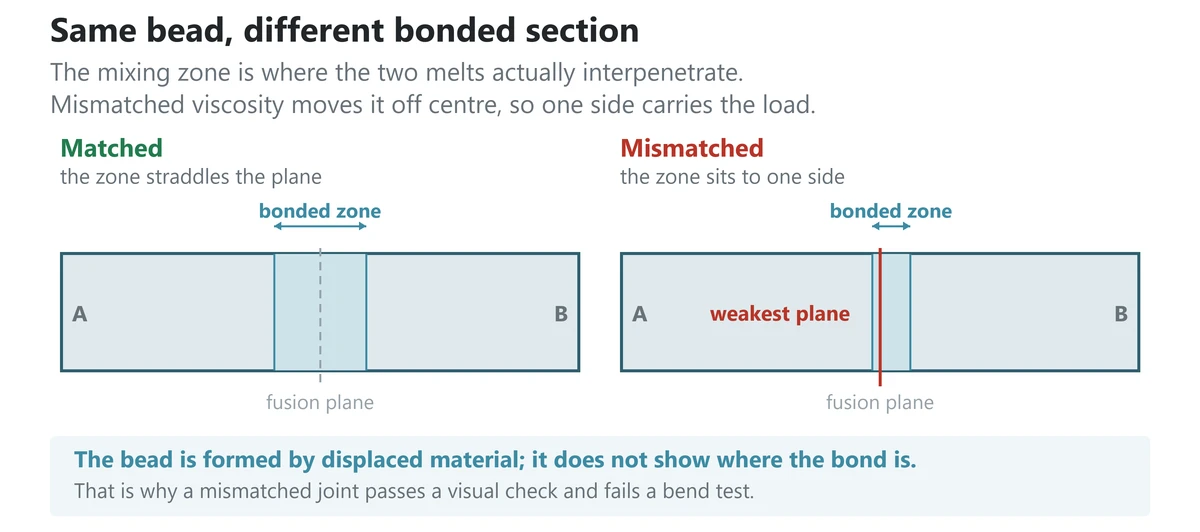
Melt flow rate. MFR is a proxy for molecular weight and chain length, and it controls how the melt behaves under the joining pressure. Two materials with very different MFR values produce a joint in which one side has flowed substantially and the other has barely deformed. The mixing zone ends up on one side of the plane rather than straddling it. The joining pressure is calculated from wall thickness and ram area and has no term for viscosity, which is why a pressure setting that suits one material can under- or over-displace the other - the calculation itself is in how to calculate butt fusion pressure.
Density and comonomer distribution. These set the crystallisation behaviour. A material that crystallises early has already developed stiffness while its partner is still molten, which locks in a shear stress across the interface as the joint cools. The joint is bonded, but it carries a built-in residual stress from the day it was made. Ambient conditions shift both crystallisation and cooling on each side differently, which is covered in welding PE pipe in rain, heat and cold.
Grade and minimum required strength. PE63, PE80 and PE100 are classes defined by minimum required strength - 6.3, 8.0 and 10.0 MPa respectively - not brand names. Two materials of the same grade can still differ in MFR and in additive package, so grade alone is not a compatibility certificate. But a grade difference is a reliable signal that the two materials were not designed to be the same thing. Where a contract names a joining document, that document carries the compatibility requirement, and the split between the two main families is covered in DVS 2207 vs ISO 21307.

What happens at the interface when they do not match
The visible bead gives almost nothing away. What changes is the bonded zone. This is the opposite of a geometric defect, where the bead is the main evidence - the bead-inspection side of that is covered in asymmetric bead and misalignment.
With matched materials, the two melt fronts meet and interpenetrate roughly symmetrically, and the bonded layer sits across the fusion plane with similar thickness on both sides of it. With mismatched viscosity, the low-viscosity side spreads further before it stiffens. The result is a bonded zone that is thin and one-sided, with a plane of weakness close to one of the two original surfaces.
The consequences accumulate in a specific order. The joint has a smaller effective bonded section. The residual stress from differential crystallisation sits across that smaller section. And because the two materials age differently, the additive depletion front moves through them at different rates, so the interface becomes chemically the least protected zone in the wall as well as mechanically the weakest. That is why these joints fail late, slowly and without the ductile tearing that a correct joint shows in a bend test. Where that residual stress opens a crack, and how to read it on the bead, is covered under bead cracking after butt fusion.
| Class | Minimum required strength | Typical service | A mixed joint is rated at |
|---|---|---|---|
| PE63 | 6.3 MPa | Legacy low pressure water and irrigation | PE63 |
| PE80 | 8.0 MPa | Older distribution mains, gas and water | PE80 |
| PE100 | 10.0 MPa | Current pressure pipe for gas and water | PE80, when joined to PE80 |
PE80 to PE100: weldable, but not at the same rating
Joining PE100 pipe to existing PE80 is routine in rehabilitation and in extensions to older networks, and the two materials are chemically compatible - both are polyethylene and both melt and diffuse. What does not transfer is the pressure rating.
A PE80 pipe and a PE100 pipe of the same SDR have the same dimensions and different strengths. The joint between them is a joint between a 8.0 MPa material and a 10.0 MPa material, and it has to be rated on the weaker of the two. Designing the mixed section at the PE100 rating assumes a strength that half the joint does not have.
The practical rule that follows is not "never mix". It is: check that the MFR values are within the range the material suppliers allow for fusion, weld with the parameters appropriate to the lower grade, and rate the resulting section at that lower grade. Where the specification does not permit a mixed joint at all, the answer is a flanged or mechanical transition rather than a fusion joint - which is a design decision, not a field one.
The cases that are not weldable at all
Some combinations are outside the question of parameters entirely.
Polyethylene to polypropylene, PVC, PVDF or metal. These are different polymers with different melting behaviour and, in most cases, no adhesion at the interface. No butt fusion parameter set makes them bond. They are joined with a transition fitting designed for the pair, or with a flange.
Polyethylene with a substantial recycled content, used in pressure service. Recycled material varies in molecular weight, in additive content and in contamination level, and the variation is not characterised to the same standard as virgin compound. Most gas specifications prohibit it outright in pressure pipe. Where a recycled-content pipe is permitted for non-pressure use, it is still a material whose fusion behaviour is not predictable from its marking.
Unidentified pipe. Pipe with no legible marking, or marking that does not correspond to a traceable standard, is outside the compatibility question because there is nothing to compare it to. Treating it as "probably PE100" is a guess with a twenty-year consequence.
| Combination | Fusable | Condition |
|---|---|---|
| PE100 to PE100, same grade, close MFR | Yes | Standard parameters for the wall thickness |
| PE100 to PE80 | Yes, conditional | Lower grade parameters, section rated at PE80 |
| PE100 to PE63 | Conditional | Same principle, and only where the specification allows it |
| Same grade, MFR far apart | No | Outside the range the suppliers allow for fusion |
| PE to PP, PVC or PVDF | No | Transition fitting, not a fusion joint |
| PE to steel | No | Transition fitting or flange |
| Unknown or recycled material | No | Establish the material before anything is cut |
Reading the pipe before you cut it
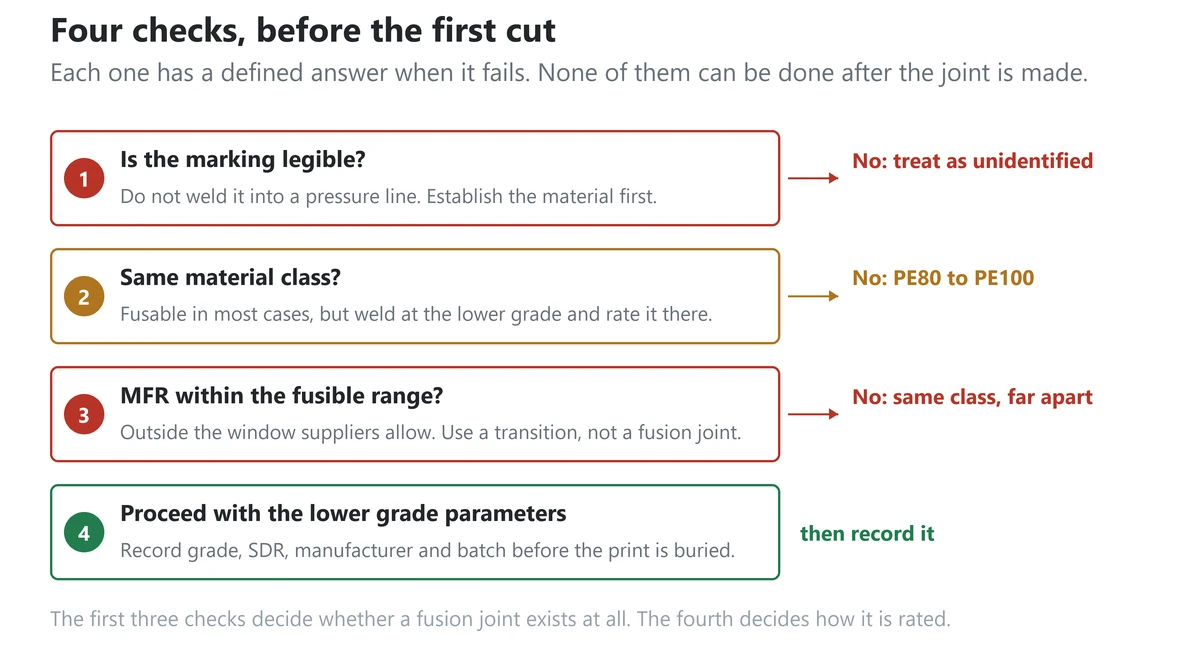
The only reliable control at the point of use is the marking on the pipe itself, read before anything is cut.
Standard PE pipe carries its material class, its dimensions, the standard it was made to, the manufacturer, and usually a production date and a batch reference. The material class and the SDR together give the pressure rating; the manufacturer and batch give traceability. Where the marking has been abraded away in handling or covered by a protective wrap, the section is unidentified until proven otherwise, and proving it means a laboratory test rather than a visual check.
Two practical points that are easy to miss. First, the same manufacturer can supply two grades through the same depot, and the difference is only in the print line. Second, a fitting and a pipe of the same nominal grade can still come from different compound sources, which is why the fitting manufacturer's compatibility statement matters as much as the pipe's marking. Where that check sits in the sequence of work is set out in butt fusion fittings construction sequence - it belongs before the first cut, not before the first weld.
What a destructive test can and cannot tell you
A bend test to EN 12814-1 or a tensile test to ISO 13953 on a sample joint will show whether the joint is sound. It will not tell you why a bad one is bad.
A brittle fracture running along the fusion plane is consistent with material mismatch, with a cold joint, and with an over-fused joint in which the wall around the plane has degraded. All three produce a flat, low-energy failure surface. The test result establishes that the joint must be rejected; it does not establish the cause, and that distinction matters because the correction is different in each case.
Establishing mismatch specifically requires laboratory work: melt flow rate measurement on samples from both sides, differential scanning calorimetry to compare crystallisation behaviour, and in some cases infrared spectroscopy to compare the additive and carbon black content. This is a post-mortem technique, not a production control. The reason to know it exists is that it converts "we think the material was wrong" into a fact, which is what a claim or a root cause investigation needs. Before that stage, the only non-destructive evidence available on an installed joint is whether an unbonded region is present at all, as described in NDT inspection of HDPE welds.
Designing around a mixed joint
Where the material situation cannot be resolved, the joint can still be engineered out of the problem.
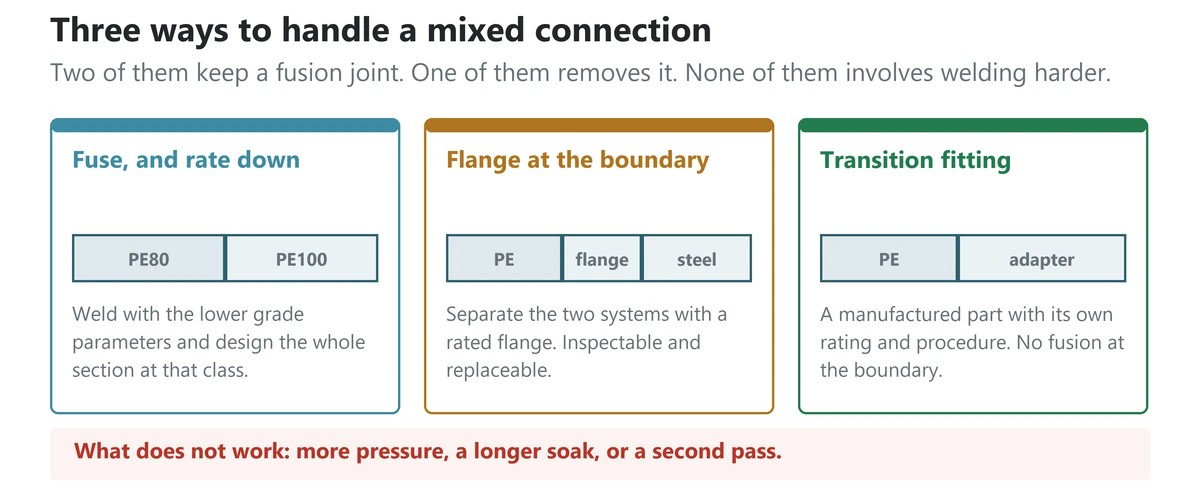
Rate it at the lower grade. The simplest response for a PE80 to PE100 transition: accept the joint, weld it with the lower-grade parameters, and design the section at the lower pressure class. This keeps a fully fused pipeline and is what most rehabilitation specifications do.
Put a flange at the interface. A flanged connection separates the two material systems and removes the mixed joint entirely. It is also inspectable, replaceable and testable, which matters on a boundary between an old network and a new one. The cost is a flange pair and the space for it.
Use a purpose-made transition fitting. For PE to metal, and for PE to other polymers, the transition is a manufactured item with its own pressure rating and its own installation procedure. It is not a field modification of a fusion joint.
What does not work is welding the mixed joint and then compensating with extra pressure, a longer soak or a second pass - and the more automated the machine, the more completely it will execute a parameter set that is wrong for one of the two materials, as set out in semi-automatic vs fully automatic butt fusion. None of those change the viscosity mismatch or the crystallisation difference, and all three add heat history to a joint that is already the least predictable one in the run.
Rehabilitation projects: the highest risk case
The mixed joint is most likely to appear exactly where the pressure to finish is highest: a live network being extended or repaired, an old main of uncertain provenance, and a crew under time pressure holding two different pipes.
Three habits reduce the risk without adding much time. Photograph the marking on every length before it is cut, so the material record exists even after the print has been buried. Keep PE80 and PE100 in separate bundles on site rather than in one pile. And decide the transition method at the design stage, so the field decision is "fit the flange" rather than "weld it and see".
Where the existing main is of unknown material, a short sample cut out during the tie-in is worth keeping. It can be tested later if a joint in that section ever fails, and it costs nothing at the time. The record-keeping habits that make a material trace possible at all are the same ones covered in welder qualification and operator training.
Checklist
- Read the marking on every length before cutting, and record the grade, SDR, manufacturer and batch.
- Never weld unidentified pipe into a pressure line. Establish the material or use a mechanical transition.
- Confirm the MFR values of both sides are within the range the material suppliers allow for fusion.
- Weld a mixed PE80 to PE100 joint at the lower grade, and rate the section at the lower grade.
- Do not weld PE to PP, PVC, PVDF or metal. Use a transition fitting or a flange.
- Keep different grades in separate bundles on site so the wrong pipe is not picked up in a hurry.
- Photograph the marking of every length used in a mixed section.
- Keep a sample of any unknown existing main cut out during a tie-in.
The joint-level defects that a mixed joint tends to be confused with - a flat fracture surface with no ductile tearing - are covered in cold weld in HDPE butt fusion and in over-fusion in PE pipe welding. The full defect picture, including how several causes can produce the same appearance, is in HDPE pipe fitting defects and their causes.
Frequently asked questions
Can PE100 pipe be welded to PE80 pipe?
Yes, where both are polyethylene and both fall within the fusible MFR range, which is the usual case in rehabilitation work. The joint must be welded with parameters appropriate to the lower grade and the resulting section rated at PE80, not PE100. Where a specification forbids mixed joints, the transition is made with a flange instead.
Can you weld two different brands of PE100 together?
Usually yes, and this is normal practice - pipes and fittings frequently come from different manufacturers. The requirement is that both are the same grade and that their MFR values are close enough to be within the range the material suppliers allow. Two PE100 materials at opposite ends of the permitted MFR window are a bigger risk than a PE80 and a PE100 at similar MFR.
Does a hydrostatic test prove a mixed joint is sound?
No. A short hydrostatic test proves the joint holds pressure today. Material mismatch produces a bonded section that is thinner and more highly stressed than it should be, and the failure mechanism is slow crack growth under long-term load. That is not measurable in a field pressure test of practical duration.
How can material mismatch be detected after the fact?
By laboratory testing of samples from both sides of the joint: melt flow rate, differential scanning calorimetry for crystallisation behaviour, and infrared spectroscopy for additive and carbon black content. On site, the only controls are the pipe marking and the batch record. Visually, a mismatched joint is indistinguishable from a sound one.
Is recycled HDPE allowed in pressure pipe?
Most gas specifications prohibit recycled content in pressure pipe, and many water specifications restrict it to non-pressure applications. The reason is not only strength: recycled material varies in molecular weight, additive content and contamination, so its fusion behaviour cannot be predicted from its marking. Where it is permitted, it is on the basis of a tested and certified compound rather than generic recyclate.
What is the right transition between PE and steel?
A manufactured transition fitting with its own pressure rating and installation procedure - typically a PE stub end fused to the pipe and mechanically joined to a steel flange, or a purpose-made PE to steel adapter. Welding is not involved at the material boundary. The transition is a rated component, not a field joint.
Send Inquiry