



90 Degree Electrofusion Elbow | HDPE Gas and Water, PE100
SDR11 PE100 Electrofusion Elbow - PN16, dn25 to dn630
Most buyers arrive at this page with one number in mind: SDR11. It sits in the middle of the PE100 wall series, it is the workhorse of gas and water distribution, and it is easy to confuse with SDR17 because the two are often quoted side by side on the same bill of materials. This page treats the SDR11 electrofusion elbow as the subject rather than as a footnote, and it treats the SDR11 pipe pressure rating as something to be derived rather than assumed. The dimension schedules below are the ones we publish and the ones we ship against; nothing here is rounded inwards to look better on paper.
A PE100 electrofusion elbow is a moulded or machined change of direction whose socket carries a resistor wire. When the two ends are connected to PE100 pipe and the fitting is energised, polymer at the interface melts, swells and fuses. The strength of that joint does not come from the fitting alone - it comes from the fitting and the pipe being compatible in wall series, which is why the SDR marking decides whether the joint is sound. Specify pe100 sdr11 pn16 for PN16 duty and SDR17 for PN10 duty, and do not mix the two in the same welded run unless the design deliberately allows a reduced-pressure transition.
SDR11 Explained: Wall Thickness, PN Rating and MRS

Section drawing: the three schedule dimensions - body outside diameter, leg length and centre-to-face length - measured on a 90 degree electrofusion elbow.
SDR is a ratio, not a pressure. It says that the outside diameter of the pipe or fitting body is a fixed multiple of its wall thickness: SDR = D / e. An SDR11 wall is therefore roughly one eleventh of the outside diameter, and an SDR17 wall roughly one seventeenth. A thicker wall at the same diameter means a smaller ratio and a higher pressure class, so the SDR number falling means the pressure capability rising.
The pressure class follows from the ratio through the long-term material strength of PE100, usually quoted as MRS 10 bar. The working relation is the standard ISO 12162 expression: PN = 20 x MRS / (SDR - 1). Substituting MRS = 10 bar gives PN = 200 / (SDR - 1), which yields PN16 for SDR11 and PN10 for SDR17. This is why a PE100 gas network in China is routinely described as SDR11 / PN16 and a PE100 water main as SDR17 / PN10, even though both are the same resin. If you are looking for the sdr11 vs sdr17 pressure rating answer in one line, that relation is it.
What MRS 10 means for the design
MRS is the 50-year hydrostatic strength of the material at 20 °C, not a pressure and not a burst figure. Design stress is derived from it by dividing by a safety factor, and the design pressure of a single pipe wall is then that stress divided by the SDR ratio. Because the derivation assumes 20 °C and a 50-year horizon, real installations derate: the PE100 gas design guidance treats SDR11 as PN16 at 20 °C but asks for a lower class once the line runs hot or the service is intermittent. Any project working above 40 °C should be engineered against the temperature derating table rather than against the SDR label alone. The same derivation is what answers the question "what pn rating is sdr11" - PN16, for PE100, at 20 °C.
One practical consequence: a thinner SDR17 wall costs less material per metre and weighs less on the truck, which is why PN10 lines are specified that way. An SDR11 elbow carries roughly half again the wall of an SDR17 elbow at the same diameter, and the extra mass is visible in the handling and in the butt-fusion cycle time rather than in the price list.
Product Data Sheet
The table below is the standing data sheet for this fitting. It applies to the whole size range, not to a single diameter, and the values are the ones written on the carton and quoted in the factory quotation.
| Fitting designation | HDPE electrofusion elbow, 90 degree |
| Resin grade | 100% virgin PE100, no regrind |
| Size coverage | dn25 – dn900 |
| SDR options | SDR11 (PN16) and SDR17 (PN10) |
| Pressure class | PN16 in SDR11, PN10 in SDR17 |
| Standards | ISO 4427 and EN 12201 (water); ISO 4437 and EN 1555 (gas); GB 15558 for Chinese gas networks |
| Joining | Electrofusion - barcode-controlled weld cycle, any compatible EF welding machine |
| Head loss through the bend | A long-radius 90° typically carries 0.6 to 0.9 velocity heads; a two-bend 45° sweep replaces it at about 0.4 |
| Colour and marking | Black, UV stabilised; gas-grade yellow marking on request |
| Service media | Natural gas and LPG distribution; potable water and industrial process lines |
| Typical installations | Gas distribution, water mains, valve and meter chambers, rising mains, process circuits |
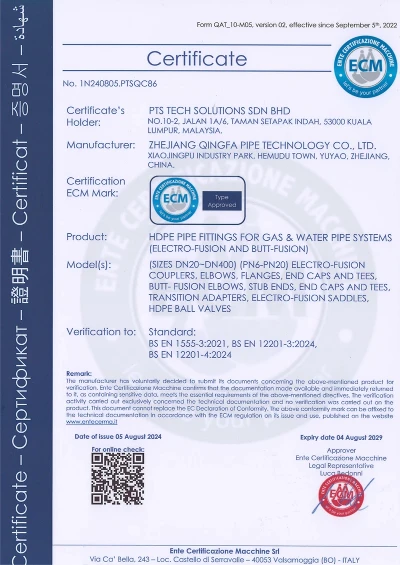
| Approvals | ECM type approval DN20 – DN400; ECM attestation DN20 – DN1200 for markets outside the EU; WRAS on the injection moulded range |
| Design life | 50 years and over under the rated conditions of the wall series |

| Company | Zhejiang Qingfa Pipe Technology Co., Ltd. |
| Business | Manufacturer of PE100 electrofusion fittings, butt fusion fittings and HDPE valves |
| Works address | No. 288, Qianguo North Road, Yuhang District, Hangzhou, Zhejiang, China |
| Website | www.qingfaindustry.com |
| Sales | sales@qingfaindustry.com |
| Telephone | +86-571-8938-8888 |
Moulded Sizes and Machined-to-Order Sizes
The elbow is made two ways, and the split is a production fact rather than a quality tier. Up to the moulding limit the body is injection moulded, which is fast, repeatable and cheap per piece. Above that limit the body is turned from solid PE100 on a CNC lathe, which is slower and more expensive per piece but is the only practical way to get a sound body in those diameters at all. A buyer listing hdpe sdr11 fittings on a schedule is really making a choice between these two routes as soon as the diameter crosses the line.
Within the SDR11 series the changeover sits between dn500 and dn560. Within SDR17 it sits between dn500 and dn560 as well, so the two series cross over at the same diameter even though the moulded ranges start and end at different places: SDR11 moulding begins at dn25 and SDR17 moulding begins at dn110. If your specification says "SDR11 dn25 to dn630", the dn560 and dn630 items are machined to order, and the lead time is the machining slot rather than the moulding slot.
| Size band | SDR | How it is produced | Lead-time character |
|---|---|---|---|
| dn25 – dn500 | SDR11 | Injection moulded, standard production range | Stock item |
| dn560 – dn630 | SDR11 | CNC machined to order from solid PE100 | Machining slot |
| dn110 – dn500 | SDR17 | Injection moulded, standard production range | Stock item |
| dn560 – dn900 | SDR17 | CNC machined to order from solid PE100 | Machining slot |
SDR11 Dimension Schedule, dn25 to dn630
The published SDR11 schedule runs from dn25 to dn630 in nineteen sizes. Every value is carried over unchanged from the previous version of this page so that drawings, tender documents and as-built records stay comparable; only the presentation has changed. The three dimensions are the body outside diameter, the leg length measured on each end, and the centre-to-end-face length taken over the outside of the bend. Read it as the fitting equivalent of an sdr11 pipe chart: the same ratio logic, applied to a moulded body instead of a pipe wall.
The outside diameter column is the one to check against your pipe. An SDR11 elbow body is slightly larger than the OD of the pipe it takes, and the electrofusion process uses that difference deliberately: the socket is slightly oversized so that when it expands against the pipe it develops contact pressure across the full circumference. A body that matches the pipe exactly would fuse badly, so a small positive difference is correct, not a manufacturing error.
| DN | Body OD (mm) | Leg L1 (mm), each end | Centre to face L (mm) |
|---|---|---|---|
| dn25 | 40±2 | 42±2 | 55±3 |
| dn32 | 46±2 | 44±2 | 60±3 |
| dn40 | 56±2 | 45±2 | 70±3 |
| dn50 | 65±2 | 50±2 | 77±3 |
| dn63 | 80±2 | 53±2 | 86±3 |
| dn75 | 95±2 | 60±3 | 100±4 |
| dn90 | 112±2 | 63±3 | 110±4 |
| dn110 | 135±2 | 73±3 | 130±4 |
| dn125 | 153±2 | 74±3 | 138±4 |
| dn160 | 194±2 | 85±3 | 168±4 |
| dn200 | 241±2 | 98±3 | 200±5 |
| dn225 | 272±2 | 105±3 | 218±5 |
| dn250 | 301±2 | 110±3 | 238±5 |
| dn315 | 380±3 | 118±3 | 278±5 |
| dn355 | 428±5 | 145±4 | 320±6 |
| dn400 | 480±5 | 158±6 | 365±8 |
| dn450 | 544±5 | 160±8 | 386±8 |
| dn500 | 602±6 | 185±10 | 435±10 |
| dn630 | 756±6 | 195±10 | 515±10 |
SDR17 Dimension Schedule, dn110 to dn900
The SDR17 schedule is published alongside the SDR11 one for the same reason: a single specification frequently calls for both, and the reader should be able to see the size steps of each without switching documents. It runs from dn110 to dn900 in fourteen sizes, and it is the schedule that governs the upper half of the size coverage on this page.
Note what the SDR17 list does not contain: there is no dn25 through dn90 entry, because the moulded SDR11 elbow starts at dn25 and the moulded SDR17 elbow starts at dn110. If a design needs an SDR17 wall below dn110 it needs a reducer or a different fitting family, not a smaller SDR17 elbow. The same asymmetry appears at the top end, where SDR17 reaches dn900 but SDR11 stops at dn630.
| DN | Body OD (mm) | Leg L1 (mm), each end | Centre to face L (mm) |
|---|---|---|---|
| dn110 | 130±2 | 53±3 | 110±4 |
| dn160 | 186±2 | 68±3 | 150±4 |
| dn200 | 230±2 | 80±3 | 183±4 |
| dn225 | 260±3 | 88±4 | 204±5 |
| dn250 | 288±3 | 95±5 | 225±5 |
| dn315 | 360±3 | 115±6 | 275±6 |
| dn400 | 460±5 | 195±8 | 405±8 |
| dn450 | 510±5 | 205±10 | 440±10 |
| dn500 | 570±6 | 205±10 | 455±10 |
| dn560 | 640±6 | 210±10 | 490±10 |
| dn630 | 715±6 | 195±10 | 515±10 |
| dn710 | 825±6 | 235±10 | 590±10 |
| dn800 | 925±8 | 260±10 | 670±10 |
| dn900 | 1025±8 | 275±10 | 715±10 |
SDR11 Against SDR17: A Wall Thickness Comparison
The comparison below is derived, not a separate published table. For each diameter that appears in both schedules it divides the body outside diameter already published above by 11 and by 17 respectively, and rounds to 0.1 mm. Use it to see the size of the difference in the material you are buying, and use the two published schedules above for anything that has to be fabricated or inspected.
Reading the derived wall column
The figures are nominal walls derived from body outside diameter, so they are not identical to the pipe standard wall in the same diameter and they carry no tolerance. At dn110 the SDR11 wall comes out near 12.3 mm and the SDR17 wall near 7.6 mm, and that ratio of roughly 1.6 to 1 persists across the range, because the two schedules are simply the same diameter divided by two different numbers. Where the elbow body is machined rather than moulded, the finished wall is cut to the derived nominal and then measured; the batch record carries the measured value, not the calculated one.
Where the two series share a diameter
Eight diameters appear in both published schedules: dn110, dn160, dn200, dn225, dn250, dn315, dn400 and dn500. These are the only places where the two wall series can be compared directly, which is why a search for pe100 sdr11 dn110 lands in the overlap rather than at the end of the SDR11 range. Below dn110 only SDR11 is available, and above dn500 only SDR17 continues, so a single-diameter comparison outside that band is not a like-for-like exercise.
| Shared diameter | SDR11 derived wall (mm) | SDR17 derived wall (mm) | Difference (mm) |
|---|---|---|---|
| dn110 | 12.3 | 7.6 | 4.7 |
| dn160 | 17.6 | 10.9 | 6.7 |
| dn200 | 21.9 | 13.5 | 8.4 |
| dn225 | 24.7 | 15.3 | 9.4 |
| dn250 | 27.4 | 16.9 | 10.5 |
| dn315 | 34.5 | 21.2 | 13.3 |
| dn400 | 43.6 | 27.1 | 16.5 |
| dn500 | 54.7 | 33.5 | 21.2 |
How the Weld Cycle Adapts to SDR11
The electrofusion machine does not know what an SDR11 is. It reads a barcode on the fitting and runs a fixed energy profile: current rises, the resistor wire heats, polymer melts at the interface, the fitting expands, and the cycle ends with a cooling period. What the profile must match is the total resistance of the circuit, which is the wire loop plus the pipe wall in the electrofusion zone - and the pipe wall is the part that changes between wall series.
Barcode-controlled cycle
Each fitting carries its own barcode, and the machine decodes the mould identity rather than the nominal diameter alone. A dn200 SDR11 elbow and a dn200 SDR17 elbow are different scannable parts with different programmes, and a machine will refuse a barcode whose diameter or series does not match the parameter set loaded. That refusal is a feature. Any proposal to bypass it by scanning the neighbouring size should be rejected at design stage, because the energy profile tuned for a 12 mm wall is materially over-driving a 7.6 mm wall.
Preheat and cooling time
A thicker wall stores more heat and takes longer to come back to ambient, so SDR11 cycles run slightly longer than SDR17 cycles at the same diameter. The machine holds the joint during cooling, and the fitting must not be disturbed while the weld is still above the regelation temperature. In cold ground the cooling period lengthens again, which is one reason the same fitting can cycle reliably in one climate and need a longer programme in another.
Service Limits: Temperature, Pressure and Media
SDR11 is rated PN16 in water at 20 °C, and gas networks run at a working pressure set by the operator rather than by the material. The two most common reasons an SDR11 elbow is returned or rejected are both about the installation rather than the fitting: an operator running the line above the pressure the class was chosen for, and an installer fusing SDR11 elbows into an SDR17 run by accident.
Temperature derating
The PN16 label is a 20 °C figure. PE100 loses roughly 3 % of its allowable stress for every 10 K above 20 °C, so a continuous line at 50 °C should be treated as a materially lower class even though the SDR marking is unchanged. For intermittent gas service, where the line cycles between ambient and a modest operating temperature, the derating is usually small enough to keep the SDR11 designation valid.
Gas, water and process media
The same body serves natural gas, LPG, potable water and industrial process lines, and the material approval covers them. What changes between those services is not the resin but the paperwork and the marking: gas-grade elbows can carry yellow marking and are supplied against the gas standards ISO 4437 and EN 1555, while potable water elbows are supplied against ISO 4427 and EN 12201 and are covered by the water material approval. That is the distinction behind a query for sdr 11 gas pipe fittings as against a water specification: same body, different certificate. State the medium on the order, because the certificate that travels with the batch is chosen by the medium.
Compliance File and Traceable Documents
The documents below are the ones held on file for this fitting family. They are listed with the reference number and the expiry date so that a tender check can be done against the certificate itself rather than against a claim on a website. Copies travel with the shipment on request, and the batch test record is issued per batch rather than per certificate.
Documents held on file for this fitting family, listed with reference number and expiry so a tender check can be made against the certificate itself.


Production Line and Test Laboratory
Both production routes sit under one roof. The moulding hall runs PE100 electrofusion tooling for the injection-moulded sizes, and the CNC turning cell next to it finishes the machined sizes from solid bar. Keeping both in the same building means a schedule that crosses from moulded dn500 to machined dn560 is a move between two cells rather than a shipment between two suppliers.
The test laboratory is CNAS-accredited and works to ISO/IEC 17025. Its three routine checks are coil resistance, fusion joint strength and dimensional inspection. Coil resistance is measured on every fitting because a drifting wire is the failure mode that produces a joint which looks perfect and leaks later. Dimensional inspection on the machined sizes is what confirms the derived wall discussed earlier actually landed on the drawing.

Injection moulding of large-diameter PE100 electrofusion elbow bodies.

Moulding workshop running PE100 electrofusion fitting tooling.

CNC turning cell finishing dn560 to dn900 electrofusion elbows from solid PE100.

Five-star after-sales service certificate for HDPE pipe fittings, issued under GB/T 27922-2011.
Packing, Marking and Container Loading
Cartons carry the fitting size, the SDR series, the mould or batch number, the production date and the standard reference. Private-label orders replace the factory branding on the body, the carton and the pallet with the customer artwork, so the mould identification and the certification trail have to be agreed before the first shot rather than added at the end.
Moulded elbows are nested or boxed in standard cartons and stack evenly, so a 40 foot container holds a high count of the small sizes. Machined elbows are heavier for their volume, packed in smaller cartons and braced more heavily, and the dn630 SDR11 body is the single heaviest item in this family. If the shipment is a mixed one, the machined items are loaded first and the moulded items stacked above them.
Carton, pallet and stencil
Pallets are marked with the order number, the item count and the gross weight, and the same information is stencilled on the container so that the receiving store can reconcile the carton count without opening boxes. For gas projects the consignment is normally shipped with the certificates, the packing list and, where required, a third-party inspection record, and the documents are sent ahead of the vessel so the project team can start the incoming check on arrival.

Cartoned electrofusion elbows staged in the dispatch warehouse.
Buyer Questions and Practical Answers
Hot Tags: 90 Degree Electrofusion Elbow | HDPE Gas and Water, PE100, 90 Degree Electrofusion Elbow | HDPE Gas and Water, PE100 dn25-dn630, 90 Degree Electrofusion Elbow | HDPE Gas and Water, PE100 SDR11/SDR17, 90 Degree Electrofusion Elbow | HDPE Gas and Water, PE100 dn25-dn630 SDR11/SDR17, PE100 90 degree electrofusion elbow | hdpe gas and water, pe100, 90 degree electrofusion elbow | hdpe gas and water, pe100 supplier, HDPE End Cap, End Cap HDPE Pipe, End Cap HDPE, PE PiPE End Cap, Electrofusion Test Cap, HDPE PiPE End Cap
You Might Also Like


Send Inquiry